
Applications
Copper 3D printing applications for functional parts
Use this application map to identify where copper additive manufacturing may create measurable value: thermal management, current delivery, RF and vacuum hardware, semiconductor equipment, tooling inserts, and compact fluid routing.
Application map
High-value copper AM applications
Choose the application closest to the part so geometry, operating limits, finishing, inspection, and quotation inputs can be considered together.
For boundary-condition review, cooling architecture screening, manufacturable reconstruction, and project-specific validation planning.
For liquid cooling plates, microchannels, integrated manifolds, pressure boundaries, CT inspection, and leak testing.
For copper heatsinks, dense fins, interface flatness, airflow paths, contact resistance, and thermal validation.
For compact heat exchanger cores where channel cleaning, pressure drop, walls, and finishing decide feasibility.
For high-current conductors, integrated cooling, contact faces, duty cycle, insulation, plating, and conductivity tests.
For compact three-dimensional current routing, liquid cooling, machined contact pads, plating, and conductivity evidence.
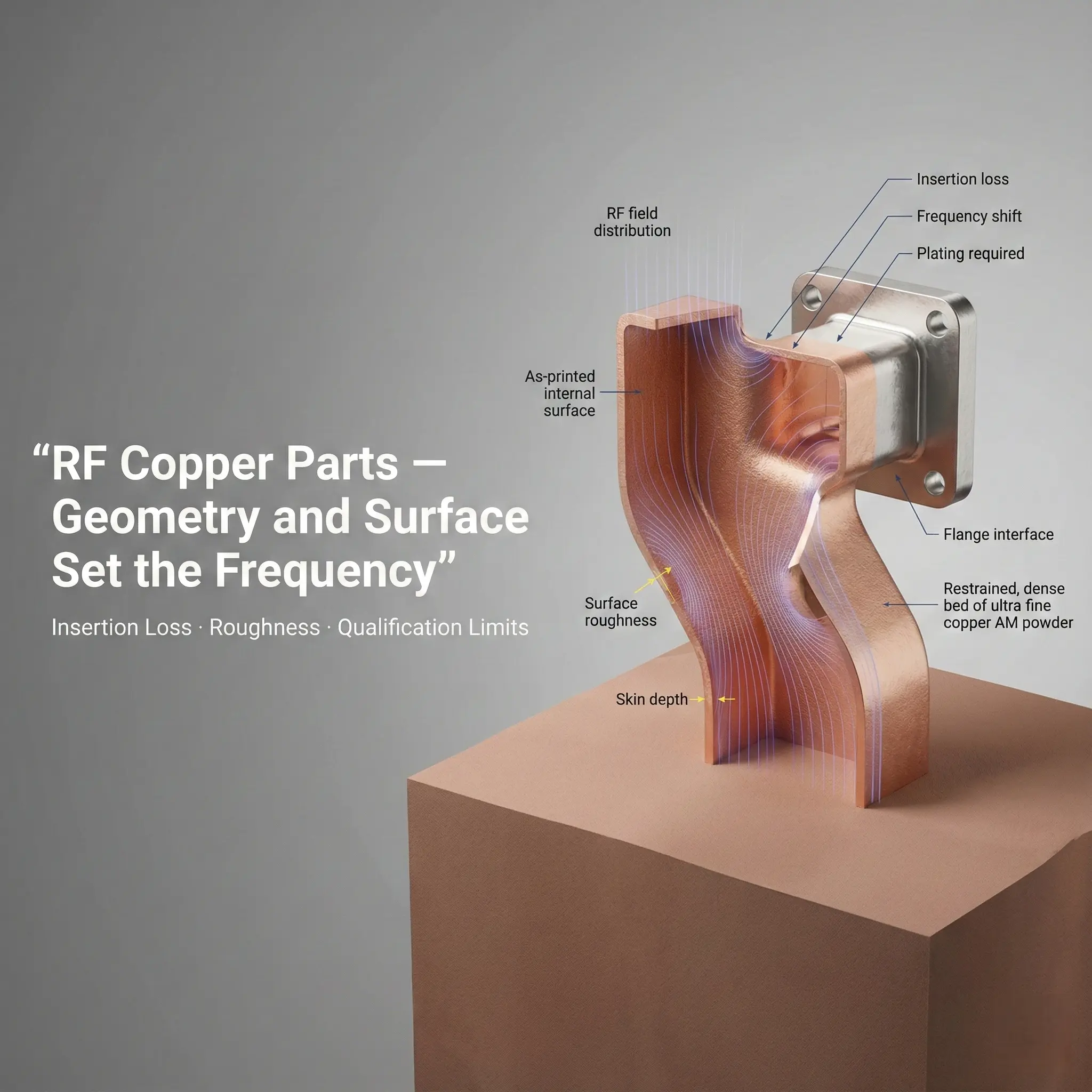
For waveguide bodies, cavities, RF surfaces, vacuum sealing, polishing, plating, cleaning, and inspection planning.
For wafer equipment cooling blocks, clean internal passages, precision copper interfaces, sealing, and leak testing.
For CuCrZr tooling inserts, hot-spot control, conformal channels, cavity finishing, pressure testing, and validation.
For GPU cold plates, SiC power modules, liquid-cooled server manifolds, compact copper routing, and quote inputs.
Where copper additive manufacturing usually earns its cost
The best applications are not generic copper parts. They combine conductivity with geometry, validation, and manufacturing-route constraints.
Thermal management is a strong copper AM application path
Most qualified copper AM inquiries start with thermal density, liquid cooling, internal channels, or interface control rather than the material name alone.
Cold plates and heat exchangers
Use copper AM when channel routing, manifold integration, pressure boundary reduction, or compact heat transfer is the real value.
Heat sinks and hybrid cooling
A printed copper heat sink needs realistic fin spacing, airflow or coolant data, flatness requirements, and a validation method.
Buyer next step
Send CAD, heat load, coolant or airflow, pressure limits, quantity, and inspection requirements for a quotation.

Specialized parts need application-specific acceptance criteria
These searches are lower volume than broad copper 3D printing terms, but the buyer usually has a real drawing, qualification need, or purchasing path.
RF and vacuum copper parts
Surface condition, plating, leak testing, cleaning, and machined sealing faces usually decide whether the route is quotable.
High-current conductors
Busbars, coils, and electrodes should define current, duty cycle, contact faces, temperature rise, insulation, and conductivity evidence.
Semiconductor copper hardware
Clean passages, thermal stability, leak targets, and precision interfaces should be stated before price is treated as meaningful.
Strong project fit
Geometry-driven copper parts
Internal channels, manifolds, thin thermal features, RF surfaces, sealing lands, or compact current paths can justify an additive route.
Evidence required
Validation-sensitive parts
CT inspection, leak testing, pressure proof, conductivity tests, flatness, roughness, cleaning, and post-machining requirements should be defined before quoting.
Usually a weak fit
Commodity copper requests
Plain copper plates, bars, wire, tubes, powder supply, hobby printer requests, and simple fabricated copper parts are usually better handled through conventional routes.
Broader evidence map
Compare 13 copper AM application domains
Review public case evidence, typical parts, buyer roles and qualification boundaries across thermal, RF, electrical, aerospace, marine, energy, tooling and semiconductor applications.
Send the CAD and operating requirements
For a useful copper AM quotation, include drawings, quantity, material preference if known, heat load or current, pressure or leak targets, critical interfaces, and inspection needs.