Materials
Copper materials for additive manufacturing
If the alloy is specified, include it with the drawing. If not, send the operating conditions so we can compare pure copper, CuCrZr, CuCr1Zr, or a specialized copper alloy route.

Common material paths
The right route is selected against the function of the part, not by material name alone.
Best suited to parts where electrical or thermal conductivity is dominant, mechanical loads are controlled, and final conductivity matters more than strength.
Useful when the part needs more strength, clamp-load stability, or softening resistance while retaining useful conductivity after heat treatment.
Important when a drawing, supplier route, or quality plan requires a documented copper-chromium-zirconium alloy designation and evidence package.
Reviewed for high-temperature thermal hardware where alloy behavior, heat treatment, and documentation may matter.
Material inputs that support a faster decision
The same alloy can behave differently depending on wall thickness, heat treatment, machining allowance, inspection scope, and operating environment.
Conductivity after processing
Conductivity targets should be discussed after stress relief, heat treatment, machining, polishing, or plating requirements are known.
Strength and service temperature
Clamp loads, pressure loads, thermal cycling, and local wall thickness determine whether pure copper is enough.
Inspection and certification
State whether material certificates, density expectations, CT review, or leak-test requirements are needed.
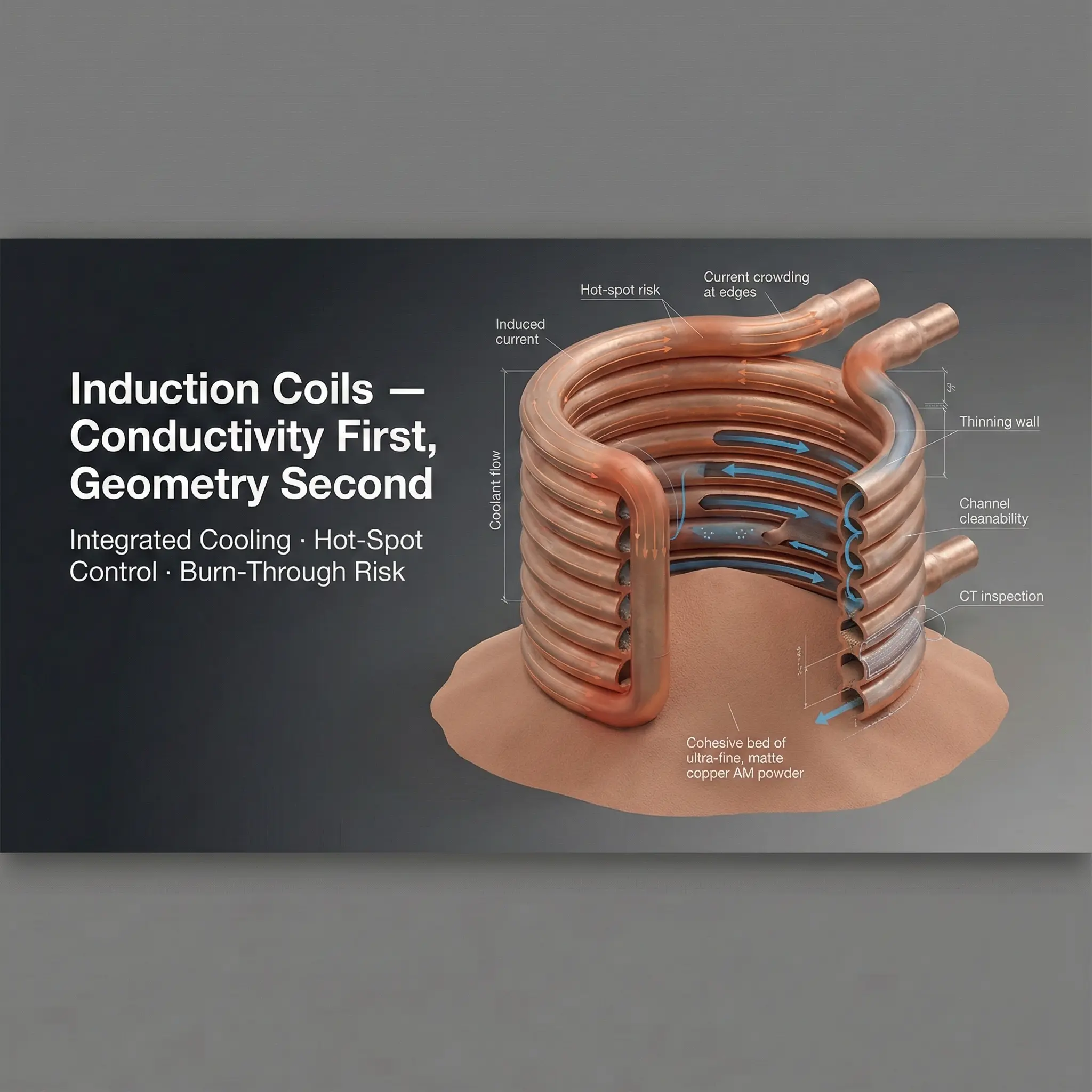
Material decision guides
Use these guides when material designation alone is not enough to define the finished copper AM part.
For conductive components, heat spreaders, busbars, and thermal parts where final conductivity evidence matters.
For thermal hardware with clamp loads, threads, pressure boundaries, thin walls, or strength after heat treatment.
For industrial drawings, supplier data sheets, or qualification routes that require documented CuCr1Zr evidence.
Property evidence
Compare copper grades in their final tested state
Use the evidence map to keep alloy, heat treatment, orientation, test method, temperature and source context attached to conductivity, strength and thermal-property values.
Not sure which copper alloy fits the part?
Send the CAD package, quantity, operating conditions, and critical requirements so we can recommend a suitable material and production route.