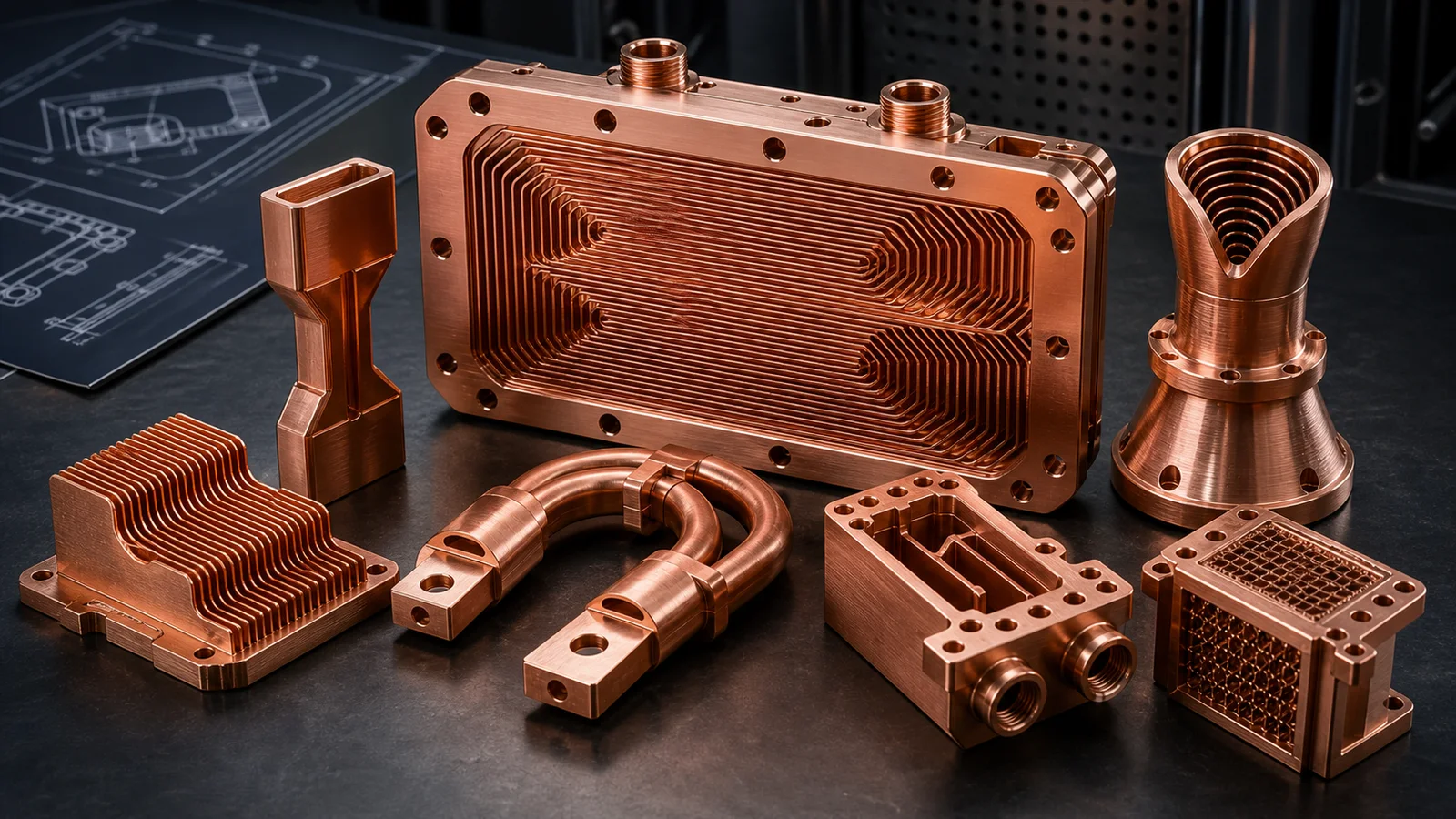
Liquid-Cooled Server Copper Hardware RFQ Guide
RFQ guide for liquid-cooled server copper hardware: cold plates, manifolds, ports, pressure drop, leak testing, cleaning, and service requirements.
Working on a copper part? Start a project review — share a brief; CAD can follow.
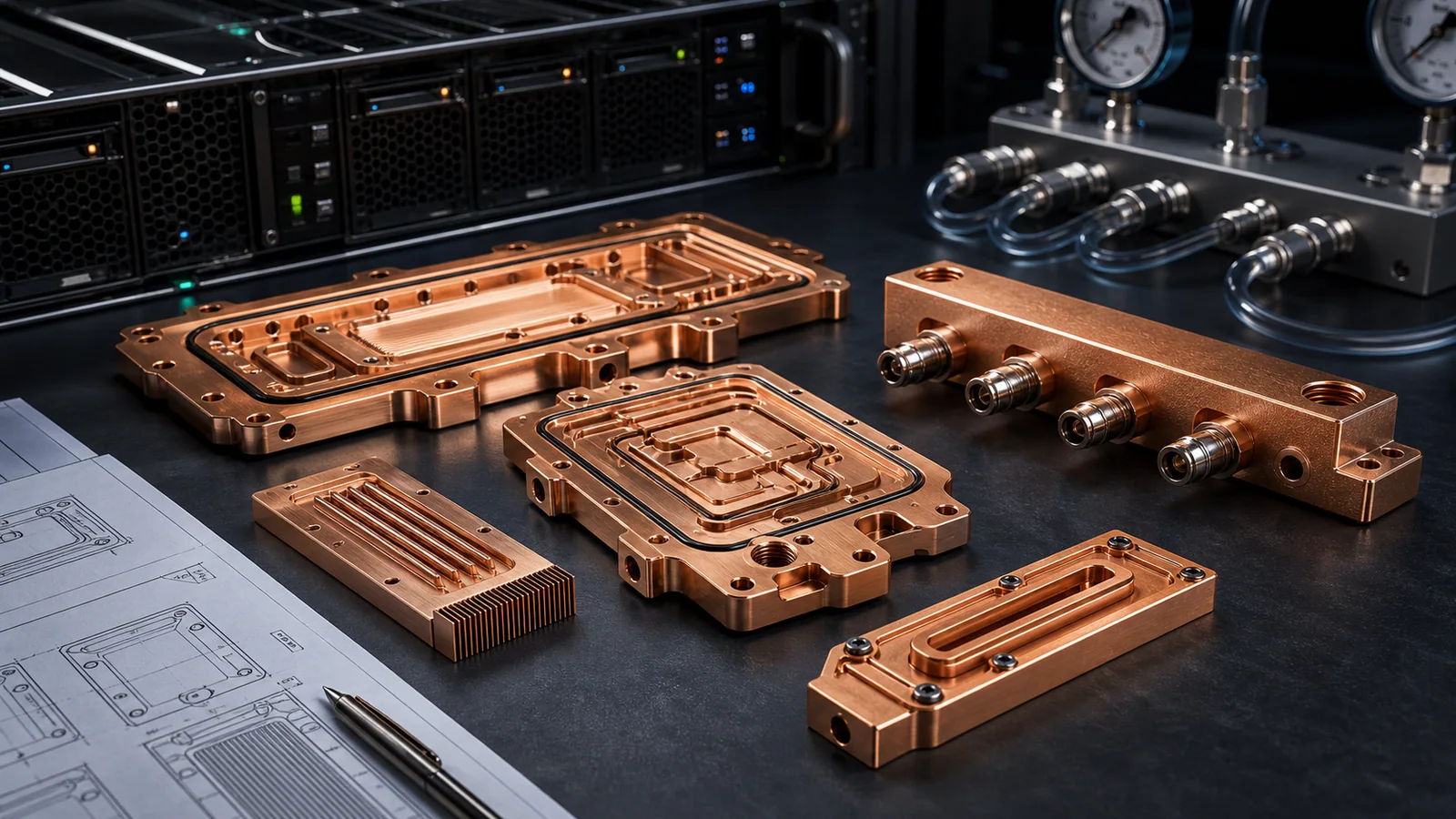
Liquid-cooled server copper hardware is worth reviewing for additive manufacturing when the cooling path, package envelope, manifold routing, or part consolidation creates value beyond a simple machined plate. Send CAD, drawings, quantity, coolant condition, pressure limits, service constraints, critical surfaces, and inspection requirements.
Server Cooling RFQs Are System RFQs
Server liquid-cooling hardware does not live alone. It connects to cold plates, manifolds, ports, quick connects, service loops, rack-level cooling hardware, and sometimes power-delivery parts. A copper part that looks manageable on a desktop can become difficult when it must fit inside a server tray, avoid neighboring components, survive handling, and pass leak acceptance.
For copper additive manufacturing, the most useful first question is:
What requirement makes conventional manufacturing weak?
The answer may be thermal density, routing, leakage risk, part count, prototype speed, or package height. If the answer is only “we want it printed,” the quote may not be strong.
Server Copper Parts That May Be Worth Reviewing
Common liquid-cooled server hardware candidates include:
- CPU, GPU, accelerator, or ASIC cold plates.
- Memory, VRM, or power-stage cooling blocks.
- Compact copper manifolds with restricted inlet and outlet locations.
- Copper heat spreaders with local internal cooling.
- Hybrid thermal-electric copper parts where current and heat share the same package.
- Prototype server cooling hardware where internal routing changes quickly.
Conventional machining, skiving, brazing, stamping, or assembly should still be considered when the part is simple. Copper AM is most valuable when the flow path, package shape, or consolidation benefit is real.
What to Send With the First RFQ
A liquid-cooled server RFQ should show both the part and the system constraints around it.
| RFQ input | Useful detail |
|---|---|
| CAD | STEP, X_T, or native CAD with internal channels included |
| Drawing | Critical dimensions, datums, flatness, sealing faces, and port notes |
| Quantity | Prototype, pilot batch, or repeat quantity |
| Coolant | Fluid type, temperature range, compatibility concern |
| Flow target | Flow rate, allowable pressure drop, or available pump range |
| Pressure | Working pressure, proof pressure, leak acceptance |
| Interfaces | Threads, tube stubs, quick-connect regions, O-ring grooves, gasket faces |
| Server envelope | Neighboring clearance, height limit, service access, cable or board conflicts |
| Inspection | CMM, pressure, leak, flow, CT, cleanliness, or documentation requirement |
If some values are unknown, say so. That is better than leaving the supplier to guess silently.
Additive Manufacturing Value: Routing and Consolidation
Liquid-cooled server hardware often becomes crowded around ports and keep-out zones. AM may be reviewed when it helps solve:
- Internal coolant routing around board components.
- Manifold transitions that would otherwise need plugs or brazing.
- Multiple heat zones with different channel density.
- Compact port placement in a limited tray envelope.
- Reduced joint count in a leak-sensitive area.
- Lower assembly complexity for prototype testing.
The part still needs realistic finishing access. If a sealing face, port, or flat heat-transfer surface matters, assume it needs post-machining unless the drawing clearly accepts an as-built condition.
Pressure Drop Should Be Defined Early
A server cold plate or manifold can be thermally attractive and still fail the system if pressure drop is too high. If the RFQ does not include a pressure-drop limit, the quote may require assumptions that later change the design.
Provide one of these:
- Target flow rate and maximum pressure drop.
- Pump or CDU capability.
- Coolant temperature and viscosity range.
- Existing baseline part performance, if available.
- Whether pressure drop is more important than local temperature reduction.
For internal channels, small changes in width, roughness, manifold balance, and bend geometry can strongly affect pressure drop. The quote should not treat internal channels as decorative features.
Leak Testing and Cleanliness Are Not Optional Details
Liquid-cooled server parts often sit near expensive electronics. Leak logic must be clear.
State:
- Working pressure.
- Proof pressure.
- Leak test method if known.
- Whether helium leak testing is required.
- Cleaning, drying, and packaging expectations.
- Whether residual powder or particles have a defined limit.
- Whether CT or flow verification is required for hidden channels.
Do not write only “must not leak.” Define how the part will be judged. For related acceptance planning, see CT scan and leak test criteria for copper cold plates.
Serviceability Changes the Design Review
A server part may pass a bench test and still be weak in the field if it is hard to assemble, replace, or inspect. Include service constraints when they matter:
- Tool access around ports and mounting screws.
- Orientation of inlet and outlet fittings.
- Need for labels or part orientation marks.
- Handling surfaces that should not be cosmetic only.
- Drain, flush, or dry route.
- Assembly sequence and gasket replacement expectations.
If the server environment restricts port placement or fitting height, include an envelope model or clear keep-out information.
Material and Surface Choices
Pure copper may be reviewed when conductivity is the main priority. CuCrZr may be reviewed when mechanical strength, threaded features, clamping, or service temperature matters.
Post-processing may include:
- Stress relief or heat treatment.
- Machining of heat-transfer faces.
- O-ring groove and sealing face machining.
- Port threading or fitting preparation.
- Surface conditioning, cleaning, and drying.
- Conductivity, flatness, CMM, pressure, leak, or flow inspection.
Use the copper cold plate page for the broader cold-plate capability view, and the materials page when alloy choice is not fixed.
When Not to Use Copper AM
Copper AM may not be the right first route when:
- The part is a simple flat channel plate.
- The design can be machined and brazed with lower risk.
- Internal channels are blind and cannot be cleaned.
- The RFQ has no pressure, flow, or leak requirement.
- Unit cost is the only driver and the geometry is simple.
- The heat-transfer face requires tight flatness but no machining allowance is included.
These are not automatic rejection points. They are signals that the design route should be reviewed before quoting.
RFQ Red Flags That Slow Server Cooling Quotes
Some server cooling RFQs slow down because the geometry is available but the operating assumptions are missing. Check for these gaps before sending:
- The CAD includes internal channels, but the inlet and outlet logic is unclear.
- The drawing says “leak test” but gives no method, pressure, or acceptance level.
- The port region is packed into a tight envelope, but no neighboring keep-out geometry is provided.
- A heat-transfer face is critical, but no flatness, roughness, or machining allowance is stated.
- The part includes long internal passages, but no cleaning or verification route is defined.
- Coolant chemistry is unknown even though corrosion, cleanliness, or seal compatibility may matter.
- The part is expected to fit a server tray, but the assembly sequence and service direction are not shown.
These points do not need to be fully solved before the first email. They should be visible. A clear list of unknowns is usually easier to quote than a drawing that hides the risk.
Practical RFQ Email
For liquid-cooled server copper hardware, send CAD, drawing, quantity, coolant, flow or pressure-drop target, working pressure, proof pressure, material preference, critical surfaces, port requirements, and inspection or cleanliness expectations.
Send files to info@szcomo.com. We review the geometry and requirements first, then quote according to the information provided.
Copper AM quotation
Is copper AM a fit for your part?
Describe the part, its job, and the question holding up your decision. Add quantity and critical requirements if known; CAD can follow.
Before you submit: Copper AM capabilities and review scope.