
Buying 3D Printed Copper Rocket Parts from China: Export Compliance First
A buyer checklist for copper-alloy rocket combustion chambers and liners: identify the end user, document the end use, and resolve export approval before committing to manufacture.
Working on a copper part? Start a project review — share a brief; CAD can follow.
A printable copper combustion chamber is not automatically an exportable product. Before ordering a rocket-engine component from China, establish who will use it, what it will be used for, and which export-control route applies. A signed end-use certificate supports review; it does not guarantee approval.
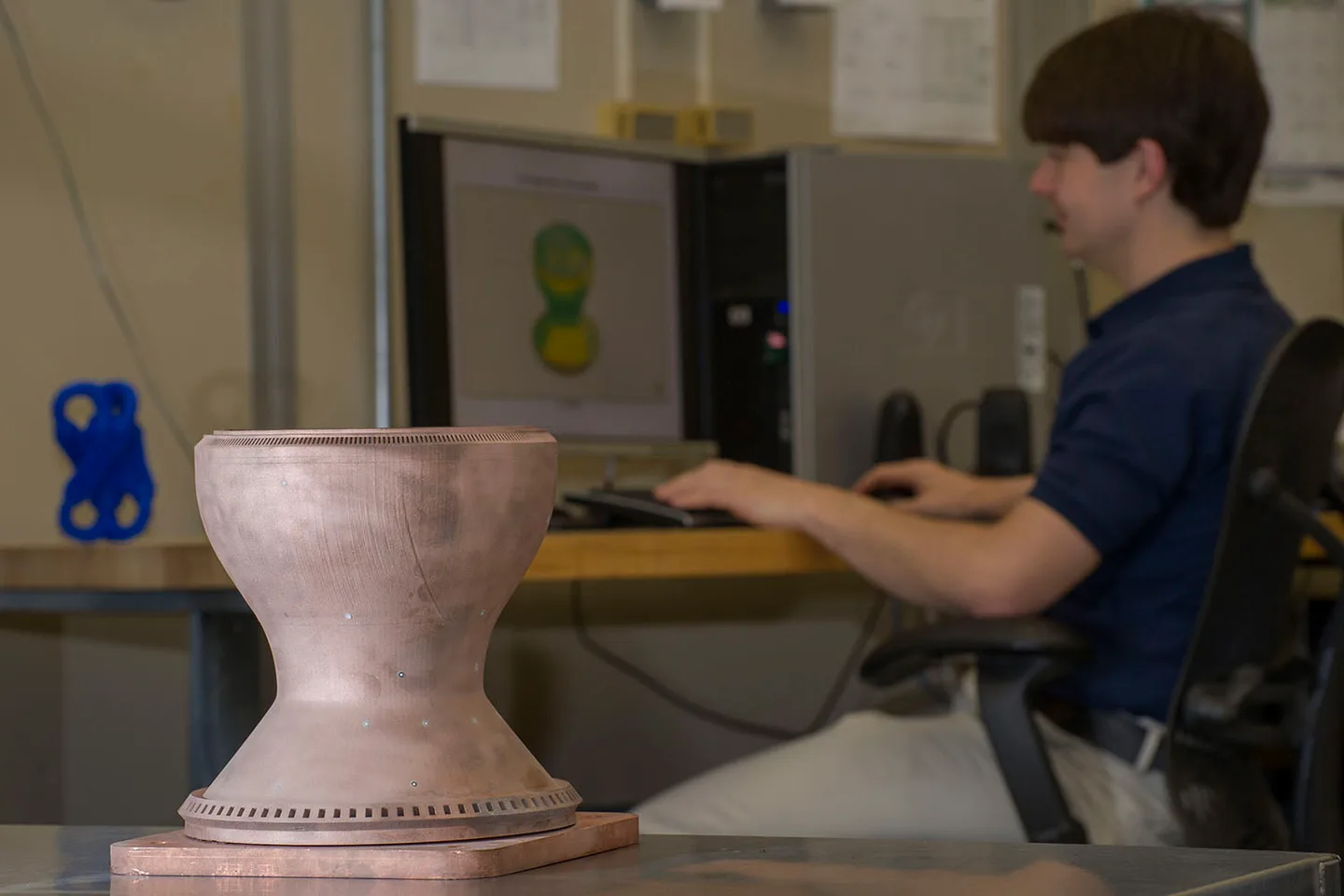
Reference image: NASA/MSFC/Emmett Given — a publicly documented copper combustion-chamber liner and dimensional-verification setup. This is not a COPPER 3DP customer part, qualification record, or NASA endorsement. Original NASA source.
An RFQ can arrive with a complete drawing and a simple question: can you print this in copper alloy? The supplier may see a plausible manufacturing route, while the buyer expects price and delivery immediately. The conversation changes when the supplier asks for the actual end user and a signed statement of use.
For this category of procurement, that information belongs at the beginning—not after the part has been built. The purpose of this guide is to help legitimate buyers prepare for that conversation without sending restricted technical data prematurely.
Scope: general procurement education, checked against the official sources linked below on 10 October 2026. This is not legal advice, a classification ruling, or an offer to supply a controlled item. Obtain transaction-specific advice from qualified export-control counsel and the competent authorities.
What is being purchased: powder, a liner, or an engine component?
A combustion chamber is the part of a rocket engine in which combustion takes place. A copper-alloy liner is an internal component of that assembly; it is not necessarily the complete chamber or engine. A drawing for a chamber, liner, nozzle-related part, or other propulsion component therefore needs a truthful functional description, not just “3D printed copper.”
NASA’s public liner example demonstrates that copper-alloy additive manufacturing is relevant to propulsion. It does not establish another supplier’s manufacturing qualification or a Chinese export classification.
Names such as pure copper, CuCrZr/CuCr1Zr, and GRCop-42/GRCop-84 identify different material families. Record the exact specified grade and delivered condition; do not substitute an alloy merely because a supplier already prints it. Material identity is necessary information, not an export decision. The copper LPBF release guide covers the separate question of manufacturing evidence.
A powder certificate describes feedstock. It is not an end-use certificate, a finished-part acceptance record, or an export licence.
Are all 3D printed rocket combustion chambers controlled in the same way?
No single classification follows from the words “copper,” “3D printed,” or “civilian research.” Review the actual item, its function, the transaction parties, destination, and intended use. Do not assign a Chinese control code by copying a US or EU code from another quotation.
China’s Export Control Law, particularly Articles 2 and 12, covers goods, technology, services, and related technical data. Listed and temporarily controlled items require permission. Unlisted items may also require permission where the exporter knows, should know, or is notified of specified national-security, weapons-of-mass-destruction/delivery-system, or terrorism risks. Absence from a keyword search is not clearance.
Use the official Chinese dual-use control-list database together with the underlying list and subsequent announcements. The database itself warns that the legal list prevails and that unlisted items can still trigger obligations. This article intentionally does not give every chamber a universal control code.
Do not overlook the military-export route
Article 47 of the 2024 Dual-Use Export Control Regulations places items and technology in Part I of the former missile-related control list under military-export management. It is therefore incorrect to treat every propulsion inquiry as an ordinary MOFCOM dual-use application.
China’s Military Products Export Regulations, Articles 7–8, 13–17 and 20, require the relevant export operating authority and project/contract/licence approvals. An ordinary machining or printing business cannot assume it may conduct military exports by collecting a customer declaration. COPPER 3DP does not claim military-export operating authority or guarantee access to that route.
For an uncertain item, the exporter should seek an authoritative determination before making an export commitment. A “commercial space” description explains intended use; it is not, on its own, a legal exemption.
Start with a short, non-sensitive project brief
Our recommended first-contact brief is deliberately smaller than a licence application. Provide only information that you are legally permitted to share:
- Your company’s legal name, country, website, and business contact.
- Whether you are the actual end user, an importer, an integrator, or a purchasing intermediary.
- The actual end user’s legal identity and the country and site where the part will be used.
- A truthful, non-sensitive description of the component and project purpose, including whether it is a ground-test or flight project and whether military involvement exists.
- The specified alloy, requested quantity, and purchasing stage, if those details can lawfully be disclosed.
- The person responsible for export compliance and whether the end user can provide signed documentation.
This is a screening brief, not a government form or permission to transfer technical information. If the end user cannot yet be identified, say so. A supplier needs to know whether the inquiry can progress before investing in a detailed manufacturing quotation.
What documents may be needed for a Chinese dual-use export application?
Where the dual-use route applies, the Chinese exporter is the applicant. The buyer supplies the overseas facts and documents that the exporter cannot create on the buyer’s behalf. The following allocation summarizes the MOFCOM dual-use export-licensing service guide; it is not the military-export procedure.
| Document | Who prepares or supports it? | Purpose |
|---|---|---|
| Licence application and applicant identity records | Chinese exporter | Identify the responsible applicant |
| Contract, agreement, or other transaction evidence | Exporter and buyer | Identify the actual transaction |
| Technical description or test report | Exporter, with lawfully shared buyer inputs | Describe the item being classified |
| End-user and end-use certificate, with Chinese translation | Actual end user; exporter coordinates translation | Establish use and undertakings |
| Importer and end-user profiles, with Chinese translations | Overseas organizations; exporter coordinates | Identify the organizations involved |
| Additional requested documents | Relevant party | Answer case-specific review questions |
Applications use MOFCOM’s business platform, with provincial commerce authorities involved as instructed. MOFCOM decides the dual-use application, alone or with relevant departments. Follow the current service instructions for originals, signatures, and submission format; uploading files is not approval.
What should an end-user and end-use certificate actually explain?
Use the applicable official template linked from MOFCOM’s service guide, not a certificate invented by the supplier. The official application-filling guide emphasizes specific use, consistent identities and contract/item references, proper signatures, and accurate Chinese translations. Confirm who is authorized to sign and explain any absence of a company seal as instructed.
“For aerospace,” “for research,” and “for testing” alone do not adequately explain the actual project. Describe the intended activity and location truthfully. If the buyer is a distributor or procurement agent, its purchase order does not identify the eventual user; disclose the onward chain and provide supporting information when requested.
Article 24 of the Dual-Use Regulations requires end-user-issued evidence and allows the authority to require government-issued or government-certified evidence as well. Do not assume every case requires identical authentication, or that a self-signed letter always suffices.
The Export Control Law, Article 16, requires undertakings against unauthorized changes of end use or transfer to third parties. These commitments continue beyond the first shipment; they are not merely quotation paperwork.
Check whether you may send the drawings before uploading them
The buyer’s transfer of CAD and technical information to China is a separate question from China’s export of the finished part. An NDA protects confidentiality; it does not grant an export authorization.
For example, US DDTC guidance on licences and other authorizations explains that regulated defense articles and services include technical data. US-origin involvement does not mean every drawing is ITAR-controlled, but the responsible compliance team must resolve applicable ITAR/EAR and other transfer restrictions before disclosure.
Do not upload classified, export-controlled, or otherwise restricted drawings to our general RFQ form. Start with contact details and a legally shareable summary. Detailed files should follow only after the applicable permissions and handling arrangements are confirmed. Chinese export approval does not replace obligations in the buyer’s or destination country’s jurisdiction.
Why manufacturing lead time is not export lead time
Keep commercial planning in separate stages:
| Stage | Decision needed before the next commitment |
|---|---|
| Initial screening | Are the parties, real use, and data-sharing permissions sufficiently clear? |
| Classification and route review | Which rules and competent authority apply? Is the proposed exporter eligible? |
| Application preparation | Are the required documents complete and mutually consistent? |
| Regulatory decision | Has permission actually been granted, and on what conditions? |
| Manufacturing and acceptance | What separately agreed evidence releases the physical part? |
| Shipment | Does the shipment match the authorization and customs requirements? |
This is a recommended project-planning sequence, not a claim that every domestic manufacturing activity requires an export licence. Agree any early engineering or production work separately, including the risk of refusal, unrecoverable cost, and schedule change. Do not equate a paid deposit or completed print with permission to ship.
Article 17 of the Dual-Use Regulations specifies a 45-working-day decision period from acceptance for the ordinary review route. Identification, expert consultation, and on-site verification time are excluded; cases requiring higher-level approval are outside that limit. This is neither 45 calendar days from an RFQ nor a guaranteed delivery date.
When the procurement conversation should pause
Our practical recommendation is to stop progressing a firm manufacturing/export commitment when:
- The buyer cannot identify the real end user or use location.
- A reseller’s identity is offered instead of the actual end user’s information.
- The proposed description disguises propulsion hardware as a generic copper part.
- The buyer will not support truthful end-use documentation or necessary follow-up questions.
- Drawings cannot lawfully be transferred, or required handling arrangements are absent.
- Exporter eligibility, destination restrictions, or transaction-party screening remains unresolved.
- The requested delivery date assumes approval before any application has been reviewed.
These are reasons to clarify or decline a transaction, not accusations that a customer is acting unlawfully. Customer confidentiality may be genuine, but it cannot substitute for the information needed to establish a lawful transaction.
Manufacturing feasibility remains a separate gate. Passing a compliance review does not establish that a supplier can deliver a qualified propulsion component; equally, an impressive sample or material certificate does not establish export eligibility.
Questions buyers commonly ask
Does a university project or a single prototype avoid the review?
Do not assume so. MOFCOM’s application guide, including its sample-export FAQ, treats controlled samples as exports requiring the applicable permission. University status and small quantity are facts to disclose, not a universal exemption. Ground-test use should be described accurately rather than treated as automatic clearance.
Can the supplier complete the final-user declaration for us?
The supplier can identify missing information and help coordinate the application. It cannot invent the end user’s identity, sign in its place, or promise how that organization will use the part. Involve the end user’s authorized representative early.
Does changing the alloy or the manufacturing process solve the issue?
Not by itself. An alloy choice or a switch from LPBF to machining does not establish whether the finished item and transaction are controlled. Classification must address the actual item and use, not a more convenient invoice description.
If we provide everything, is approval certain?
No. Complete documentation makes substantive review possible; it does not predetermine the outcome. The supplier should not promise approval or unrestricted delivery, and the buyer should not budget as if paperwork were the only remaining formality.
Start a project review without sending restricted files
Use the existing copper AM inquiry form for contact details and a non-sensitive brief. State that the request concerns a rocket-engine component, identify the actual end-user organization and country, and tell us whether an authorized representative can support the compliance review. Do not attach restricted CAD at this stage.
The first useful outcome is clarity on whether a lawful, properly documented review can proceed—not an unconditional promise to print and ship. This article does not represent COPPER 3DP as an export-licensing agent, an authorized military exporter, or a holder of propulsion flight qualification.
For the separate manufacturing discussion, see our copper material overview and engineering quotation checklist. Read those after resolving what technical information may be shared.
Official-source and review note
The legal references above are Chinese official texts or official agency guidance; the English explanations are editorial summaries, not official translations. In particular, consult the current control list, later announcements, destination/entity restrictions, and the live application instructions for each transaction. A saved checklist cannot establish today’s eligibility.
The commercial screening sequence is our recommendation, not a government-issued form. No customer drawing, identity, project specification, or confidential inquiry has been reproduced in this article.
Copper AM quotation
Is copper AM a fit for your part?
Describe the part, its job, and the question holding up your decision. Add quantity and critical requirements if known; CAD can follow.
NDA available on request. We reply within 2 business days.
Before you submit: Copper AM capabilities and review scope.
