
Engineering Checklist for Copper 3D Printed Part Quotation
Start a copper AM inquiry with incomplete requirements, choose a feasibility review or scoped quotation, and assign the open decisions before manufacturing release.
Working on a copper part? Start a project review — share a brief; CAD can follow.
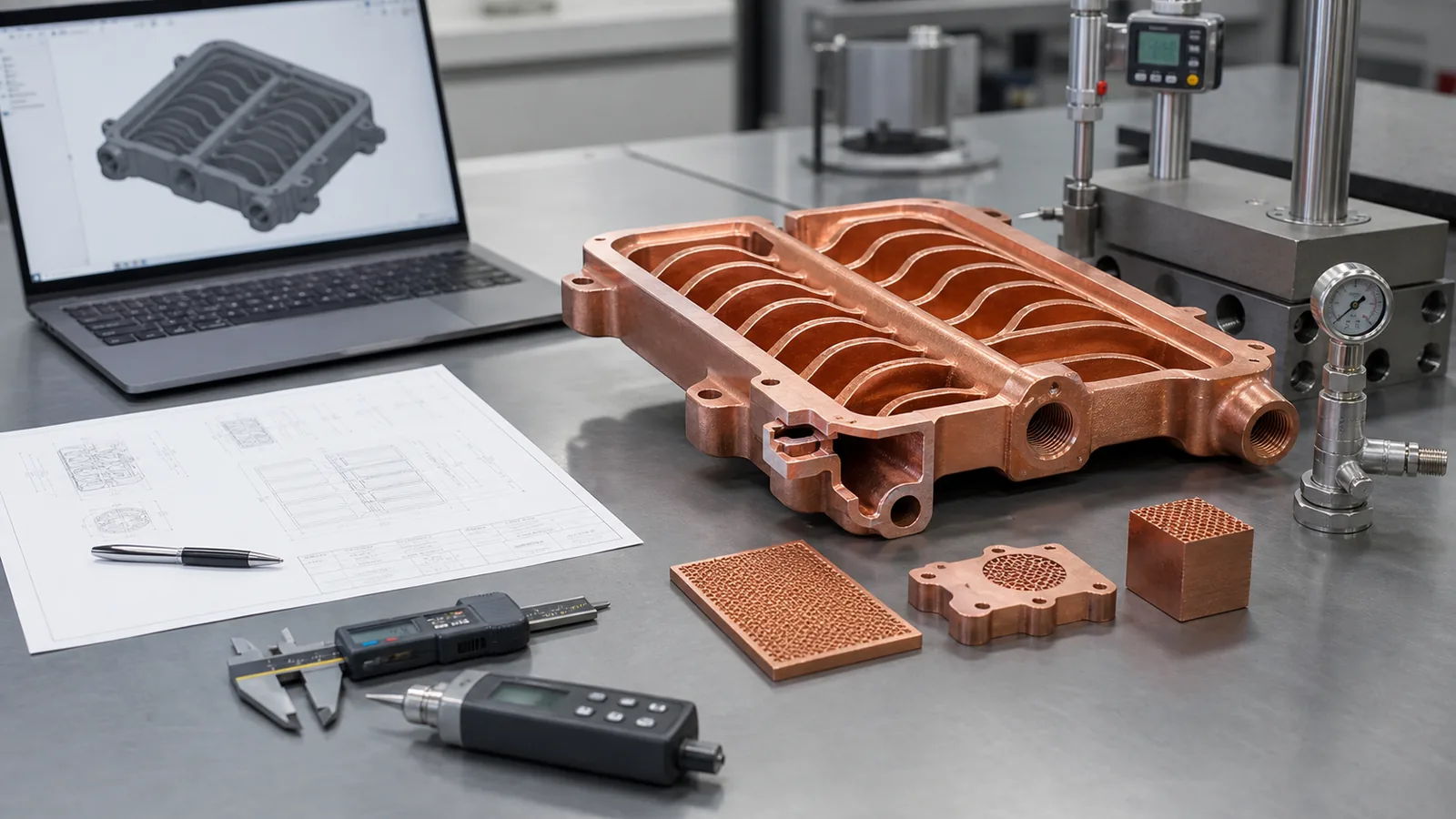
Start a copper 3D printing inquiry with the part’s function, the information available, and the decision you need next. You do not need a complete specification to make contact. A firm quotation for a functional part does need an agreed geometry, material state, finishing scope, and acceptance basis; unknowns should be named rather than silently assumed.
Use this checklist to connect the shape to its intended service and to make missing requirements visible. It is a quotation-planning aid, not a barrier to first contact.
A CAD model can look complete while the purchase requirement remains open. Ports, channels, and bolt holes show geometry; they do not specify the coolant, pressure, flatness, leak criterion, material state, machining allowance, or acceptance test.
That does not mean the part is impossible or that the inquiry should wait. It means the first response may need to be a clarification or conditional estimate rather than a firm finished-part quotation.
Copper additive manufacturing is different from ordering a simple machined bracket. Copper is chosen because it conducts heat or electricity, but the finished part often also has to work as a pressure boundary, RF surface, current path, thermal interface, vacuum component, or compact fluid manifold. The quote has to cover the full ledger: printing, heat treatment, support removal, machining, cleaning, leak testing, conductivity checks, dimensional inspection, packaging, and scrap risk.
Choose the Response You Need
Tell the reviewer what you want to decide next. This avoids treating an early design question as a production order or a budget allowance as an approved manufacturing scope.
| Requested response | Useful starting information | What still needs agreement |
|---|---|---|
| Feasibility discussion | Function, envelope or sketch, difficult feature, and why AM is being considered | Whether to investigate LPBF, revise the concept, or compare another route |
| Budgetary estimate | Preliminary geometry, quantity scenario, material direction, and known critical requirements | Named assumptions, exclusions, and changes that would require repricing |
| Firm quotation | Controlled CAD/drawing revision, quantity, final material state, finishing and acceptance requirements | Included deliverables, unresolved conditions, and the approval needed before manufacture |
These are proposed request types, not a promise that every project can be quoted. Detailed design, simulation, testing, and qualification need their own agreed scope. Use the online inquiry form for the information you have now; CAD is optional for an initial inquiry.
Start With the Function, Not the File
The first gate is simple: what must the copper part do that a conventional route cannot do cleanly?
For a heat transfer part, the answer may be coolant routing near a heat source, fewer brazed joints, or a package height below 20 mm. For a busbar or high-current conductor, the answer may be a three-dimensional current path with integrated cooling or mounting features. For an RF part, it may be a compact waveguide or cavity shape that is awkward to machine. For semiconductor equipment, it may be a mix of cooling, cleanliness, vacuum-facing surfaces, and repeatable thermal control.
State the function in one sentence before sending the RFQ:
- “This is a liquid-cooled copper cold plate for a 70 mm x 100 mm power module.”
- “This is a CuCrZr cooling manifold with internal channels and threaded side ports.”
- “This is a high-current copper conductor where contact resistance and mounting stiffness both matter.”
- “This is a copper RF component where internal surface finish and dimensional control are critical.”
That sentence tells the reviewer which risks to look for. A thermal interface may need a controlled flatness tolerance; a non-contact flow distributor may have different priorities. A pressure boundary needs an agreed pressure and leak basis, while a solid heat spreader may not. Conductivity may dominate one project, while thread stability or heat treatment may dominate another.
The Core RFQ Checklist
Use this checklist before requesting a copper 3D printed part quotation. It does not make the project expensive by itself. It prevents hidden requirements from appearing after the first price.
| RFQ input | What to provide | Why it affects quotation |
|---|---|---|
| CAD file | STEP, Parasolid, or native CAD with internal channels included | Defines build orientation, supports, powder removal, and machining stock |
| Drawing | Critical dimensions, datums, tolerances, surface finish, thread notes | Separates cosmetic surfaces from functional surfaces |
| Function | Thermal, electrical, RF, fluid, vacuum, tooling, or structural role | Tells the reviewer which failure mode matters most |
| Material route | Pure copper, CuCrZr, CuCr1Zr, or open to engineering review | Changes process window, heat treatment, properties, and cost |
| Internal channels | Section views, minimum passage size, longest flow path, branch count | Controls printability, cleaning, pressure drop, and inspection method |
| Operating limits | Temperature, pressure, flow, current, voltage, duty cycle, environment | Defines service risk and validation scope |
| Critical surfaces | Thermal face, sealing land, RF surface, contact pad, datum, thread, port | Determines CNC finishing and inspection effort |
| Acceptance tests | Leak, pressure, flow, CT, CMM, conductivity, hardness, roughness, cleanliness | Turns a printed body into an accepted component |
| Quantity and stage | Prototype, first article, pilot batch, production, target delivery | Changes fixture logic, documentation, and pricing strategy |
Do not score this table by percentage. One unresolved safety-critical pressure requirement can matter more than several completed administrative fields. Mark each item as specified, not applicable, or unresolved. The public scope of ISO/ASTM 52901:2017 addresses information exchanged when purchasing AM parts, including part definition, feedstock, final properties, inspection, and acceptance. It is not a completeness score or a copper-specific capability guarantee.
CAD Files: Show the Real Internal Geometry
A copper additive manufacturing RFQ should include the internal geometry, not only the outside envelope.
For cold plates, heat exchangers, cooling jackets, and manifolds, send a file that includes channels, ports, wall thickness, caps, bosses, and any planned machining allowance. If the channel network is confidential, send a simplified review model with the same minimum passage size, longest flow path, and port relationship. A supplier cannot judge powder removal from an outside shape.
Useful channel data includes:
- Minimum channel width and height.
- Longest enclosed channel path between openings.
- Minimum wall thickness between channel and outer surface.
- Minimum wall thickness between channel and thread or bolt hole.
- Number of branches fed by one inlet.
- Dead-end pockets, blind volumes, or trapped-powder zones.
- Cleaning access, flush direction, and planned closure method if applicable.
There is no universal quotable channel diameter. Review the complete path, access openings, orientation, powder-removal method, final surface condition, and inspection plan. Enlarging a passage may help access but also change heat transfer, pressure drop, and remaining wall thickness; it needs a geometry-specific review rather than a blanket minimum-size rule.
For broader internal-channel context, see Copper 3D Printing for Microchannel Cold Plates in Thermal Management and Copper AM Cleaning and Powder Removal for Internal Channels.
Material Choice Must Match the Acceptance Criteria
Do not write “copper” as the only material requirement if the part depends on a specific property.
Pure copper, CuCrZr, and CuCr1Zr can all make sense, but they solve different problems. Pure copper is usually reviewed when maximum thermal or electrical conductivity is the main requirement and mechanical loads are controlled. CuCrZr and CuCr1Zr deserve review when pressure boundaries, threads, clamp load, thin walls, or repeated assembly make mechanical stability part of the thermal or electrical result.
Industrial suppliers frame copper AM materials around the same engineering directions. EOS lists copper materials for applications linked to thermal and electrical conductivity, including heat exchangers, electronics, power electronics heat sinks, rocket propulsion systems, and copper coils. Eplus3D presents copper AM materials for heat exchangers, induction coils, high-frequency electronics, molding, tooling, and electronics. Those application signals are useful, but they do not replace a part-specific review.
For material selection, provide:
- Preferred alloy: pure copper, CuCrZr, CuCr1Zr, or open.
- Required conductivity, if specified.
- Required hardness, strength, or material state, if specified.
- Heat-treatment requirement or limitation.
- Service temperature range and thermal cycling requirement.
- Any standard, customer specification, or data sheet that must be followed.
- Whether witness coupons are required.
If the part is still in development, it is acceptable to say “material open to review.” That is better than forcing pure copper into a geometry that needs strength, or forcing CuCrZr into a part where maximum conductivity is the only important requirement.
Critical Surfaces Decide the Post-Processing Cost
A printed copper body is rarely the final deliverable.
The quote changes sharply when the part has machined sealing lands, flat thermal faces, RF surfaces, contact pads, threads, datum pads, O-ring grooves, or tube/fitting interfaces. These surfaces need allowance in the model and clear requirements on the drawing.
Provide these values when they matter:
- Flatness specified by the drawing’s geometric tolerance, separately from thickness or other plus/minus dimensional tolerances.
- Surface roughness target for thermal, sealing, RF, or electrical contact faces.
- Datum scheme and inspection reference.
- Thread size, depth, class, insert strategy, and torque.
- O-ring groove dimensions and compression assumptions.
- Port type, fitting standard, tube interface, or weld/braze interface.
- Machining stock, if already planned.
- Areas that must not be machined.
One hidden cost appears when the CAD model has no machining stock but the drawing requires a functional surface. Agree stock from the proposed build, distortion, heat treatment, fixturing, and final tolerance; do not copy a generic allowance. Confirm the remaining wall in the finished model, not only in the printed blank. Use the feature-based tolerance guide for the distinction between dimensional and geometric requirements.
A rough drawing with critical surfaces identified can be more useful for initial review than a rendering with no acceptance information. The controlled drawing is still needed before releasing those features for manufacture.
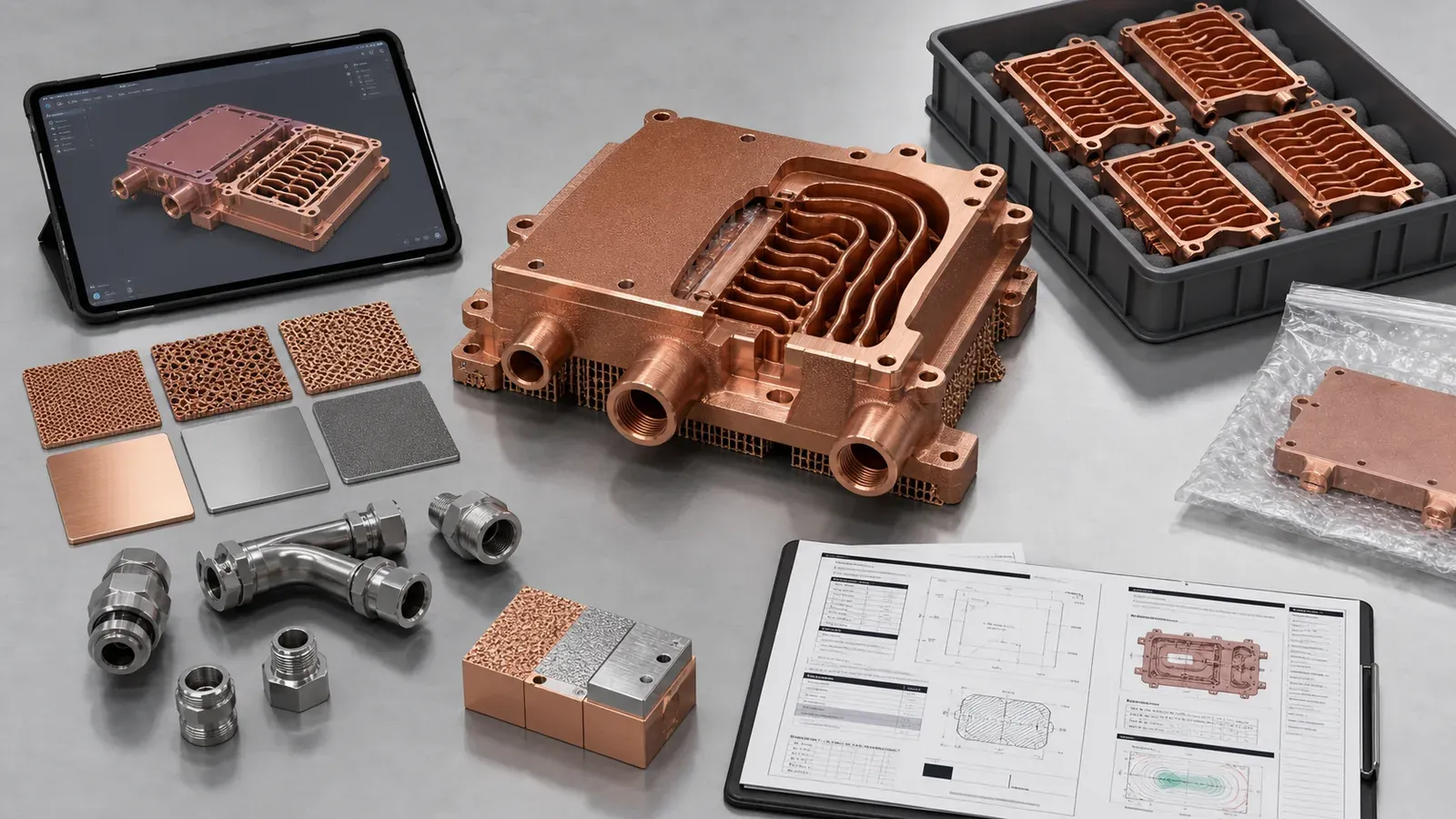
Figure 2. Illustrative RFQ input arrangement, not a customer project or inspection record. Material, channels, pressure, finishing, inspection, and batch intent all change the quote.
Operating Conditions: The Numbers That Change the Quote
For copper AM parts, operating data can be more important than the nominal dimensions.
For thermal and fluid components, provide:
- Heat load or heat-source map.
- Heat-source footprint, such as 60 mm x 80 mm or 100 mm x 120 mm.
- Coolant type, inlet temperature, and operating temperature range.
- Nominal flow rate and maximum pressure drop.
- Working pressure and proof pressure.
- Leak test method and acceptance limit.
- Cleanliness or particle requirement, if used in sensitive equipment.
For electrical components, provide:
- Current, voltage, duty cycle, and temperature rise target.
- Contact face requirements and plating requirement, if any.
- Insulation, clearance, creepage, or assembly constraints.
- Heat generated in the conductor or nearby devices.
- Torque, clamp load, and repeated assembly requirement.
For RF and microwave parts, provide:
- Frequency band and critical internal surfaces.
- Dimensional tolerances linked to RF performance.
- Surface finish and plating requirements.
- Vacuum, cleanliness, or outgassing expectations.
- Assembly datums and flange requirements.
These requirements can remain open during an initial discussion, but their status must be visible. Working pressure, proof testing, and leakage are different requirements; do not infer one from another or choose a test pressure from this article. Likewise, a conductor’s continuous current and transient duty need separate definition. The responsible design authority must confirm the operating and safety requirements for the actual assembly.
Cost Ledger: What Missing Information Does
Missing RFQ data does not disappear. It becomes risk allowance, clarification time, or rework.
| Missing item | Typical quotation effect | Better input |
|---|---|---|
| No channel section view | Supplier must assume cleaning and blockage risk | Section views and minimum passage dimensions |
| No pressure target | Leak and proof-test scope cannot be priced | Working pressure, proof pressure, test medium |
| No critical surface definition | Machining may be underquoted or overquoted | Mark thermal, sealing, RF, datum, and contact faces |
| No material state requirement | Conductivity or hardness checks may be missed | Alloy, heat treatment, coupons, test method |
| No quantity stage | Fixture and inspection strategy remain unclear | Prototype, first article, pilot, or production batch |
| No acceptance method | Finished component scope is ambiguous | CMM, CT, leak, pressure, flow, conductivity, roughness |
A test fixture can introduce its own seals, restrictions, and measurement uncertainty. Specify what is being tested and which interfaces are included. A pressure hold alone does not establish the flow characteristic of an internal channel, and a flow test does not replace a defined leak test. Fixture preparation and laboratory scheduling must be quoted for the actual scope, not assigned a generic number of days.
That is the price of clarity. It is usually cheaper than discovering the missing requirement after parts are already printed.
Assign an Owner to Each Open Requirement
This is a suggested handover worksheet, not a customer case or a mandatory division of contractual responsibility. It is useful when procurement has the CAD but must collect answers from the designer, end user, and proposed manufacturer.
| Open question | Who should confirm it? | What the quotation should record |
|---|---|---|
| What service must the part withstand? | Buyer or responsible design authority | Confirmed operating envelope; unresolved safety requirements remain open |
| Which drawing and interfaces control? | Design authority, with manufacturing review | Exact revision and approved critical features; proposed edits kept separate |
| Which alloy and final state are acceptable? | Buyer/designer and proposed manufacturer | Required properties, proposed material route, and supporting evidence |
| How will hidden passages be cleaned and checked? | Proposed manufacturer, agreed with buyer | Access concept, included checks, limitations, and required records |
| What proves acceptance? | Buyer and test provider/manufacturer | Method, conditions, limit, fixture boundary, and deliverable report |
For example, if a preliminary cooling-block model has no approved coolant or pressure basis, a discussion can still identify missing inputs. It must not quietly convert a supplier’s assumed test pressure into a released customer requirement. Ask who will close the question and before which decision: estimate, design freeze, manufacture, or acceptance.
Keep this worksheet short. Reuse the CAD release manifest for file identity and the cost guide for repricing after a scope change.
Inspection Requirements Should Be Decided Before Quotation
Inspection is not paperwork after manufacturing. For copper AM, inspection can control the entire route.
Possible acceptance checks include:
- Dimensional inspection of external features.
- CMM report for datums, hole positions, port locations, and flatness.
- Surface roughness measurement on sealing, thermal, RF, or contact faces.
- Pressure hold or proof-pressure test.
- Leak test with defined method and acceptance limit.
- Flow test at specified coolant and flow rate.
- CT inspection for internal channels, if risk justifies it.
- Conductivity or hardness checks for material state.
- Witness coupons processed with the part.
- Cleanliness, drying, and packaging requirements.
The key is to match inspection to the failure mode. CT inspection can help with internal geometry risk, but it does not replace leak testing. A conductivity coupon can support material-state confidence, but it does not prove flatness after machining. A CMM report can confirm dimensions, but it does not show whether powder remains in a long internal passage.
If the part is going into semiconductor equipment, vacuum hardware, high-power electronics, RF systems, or production tooling, define the acceptance method early. A late-added CT requirement or helium leak test can change cost and lead time more than a small geometry edit.
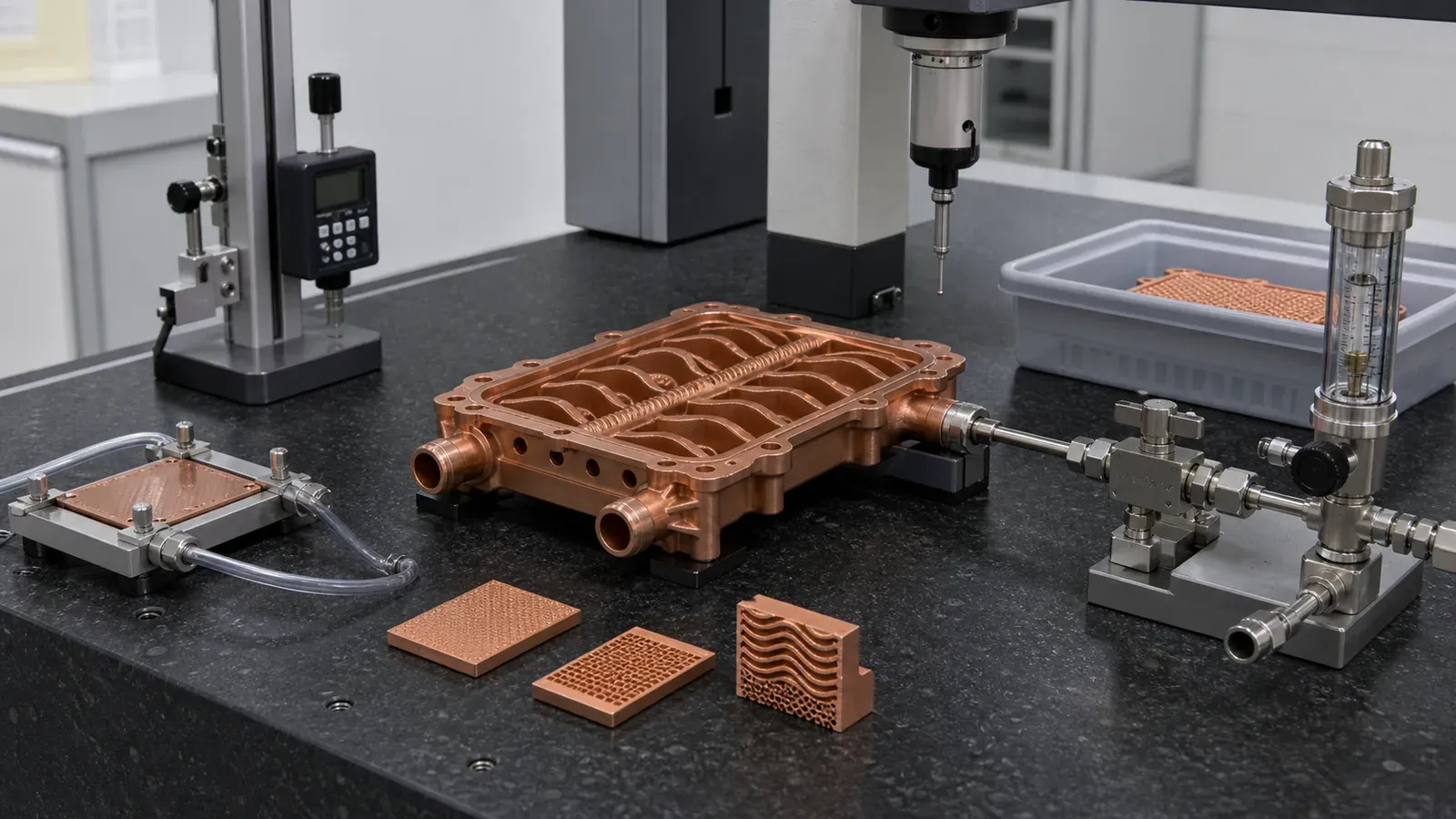
Figure 3. Illustrative validation arrangement, not evidence of an actual test. Quotation scope should identify the required checks and who supplies the acceptance records.
Lead Time: Separate Review, Build, Finishing, and Validation
Buyers often ask for one lead time. Copper AM usually has four lead-time buckets.
The first bucket is engineering review. This includes geometry screening, material selection, channel review, support strategy, machining allowance, and clarification of acceptance criteria. A complete RFQ can move quickly. An incomplete RFQ may sit for days while basic service data is collected.
The second bucket is printing and thermal processing. NIST research on highly reflective metals such as copper identifies energy-coupling challenges in LPBF. It does not establish a production schedule for a customer’s part. The schedule must allow for the proposed machine and material route, availability, build orientation, supports, stress relief, and heat treatment when required.
The third bucket is CNC finishing and cleaning. Sealing lands, thermal faces, contact pads, threads, datum pads, and port seats normally need finishing. Internal channels may need flushing, drying, and verification.
The fourth bucket is validation. Leak testing, pressure testing, flow checks, CMM, roughness, conductivity, hardness, CT, or cleanliness records can add time. Some checks are quick. Others depend on fixture availability or third-party lab schedules.
For a stage-by-stage critical path from requirements through release, use Copper 3D Printing Lead-Time Planning from Prototype to Repeat Builds. It separates processing duration, capacity waiting time, buyer hold points, and schedule-reset triggers.
If the deadline is fixed, say so. The supplier may recommend a staged approach:
- Design-for-quotation review.
- Prototype print with limited inspection.
- First article with full acceptance testing.
- Pilot batch with refined fixtures and inspection plan.
That sequence is usually more realistic than asking a first prototype to carry the full burden of production qualification.
For the first build, use the copper AM prototype planning guide to decide which questions belong to coupons, machining stock, process records, and part-level acceptance. After the first article is accepted, use the prototype-to-low-volume production control guide to define the repeat-build baseline and change controls.
A Short First Inquiry When the Specification Is Incomplete
Do not wait to complete every checklist item. Copy the brief below into the existing RFQ form or your email and leave unknowns explicit. Do not send confidential design detail until the permitted sharing scope is agreed.
Part/application:
Problem with the current design or manufacturing route:
Response needed: feasibility discussion / budgetary estimate / firm quotation
Available files and revision, if any:
Quantity or quantity scenarios:
Critical operating and interface requirements already known:
Unknowns and who can confirm them:
Design changes permitted and target decision date:
An estimate is not a manufacturing release. If geometry, material state, safety requirements, or acceptance criteria remain unresolved, identify the condition before committing the affected work. Use the pre-quotation screening guide when deciding whether to condition the quotation, request a revision, or redirect the manufacturing route.
What to Send for a Copper 3D Printed Part Quote
Before sending the RFQ to info@szcomo.com, collect:
- STEP or native CAD file with internal channels included.
- 2D drawing with datums, tolerances, critical surfaces, threads, and finish notes.
- One-sentence function statement.
- Preferred material or request for material review.
- Quantity, development stage, and target delivery date.
- Heat load, current, RF frequency, pressure, flow, temperature, or service environment.
- Coolant, gas, vacuum, or process media if applicable.
- Working pressure, proof pressure, and leak requirement for fluid parts.
- Conductivity, hardness, heat treatment, or coupon requirement if material state matters.
- Machining requirements for sealing lands, thermal faces, datums, ports, and contact pads.
- Inspection expectations: CMM, CT, leak, pressure, flow, roughness, conductivity, hardness, or cleanliness.
- Photos or assembly context if the part interfaces with existing equipment.
- Any current manufacturing route, failure history, or reason for considering copper AM.
If you do not know every value, mark it as unknown. A transparent unknown is easier to manage than a hidden requirement.
FAQ
Can we get a copper 3D printed part quote with only a STEP file?
Sometimes, but it will usually be a rough or conditional quote. A STEP file can show geometry, but it does not define pressure, flow, conductivity, surface finish, heat treatment, leak testing, or acceptance criteria. For simple prototypes, CAD and quantity may start the review. For functional copper AM parts, more data is needed.
What is the most important missing item in copper AM RFQs?
The critical missing item depends on the function; there is no universal ranking. Pressure and leak requirements can control a fluid part, while current and contact conditions can control a conductor. Identify any missing requirement that prevents defining safe service, finishing, or acceptance, and assign it to the person who can confirm it.
Should we specify pure copper, CuCrZr, or CuCr1Zr?
Specify the alloy if it is required by your drawing, standard, or qualification plan. If the project is still in design review, describe the functional priority first: maximum conductivity, pressure integrity, thread stability, heat treatment, flatness, electrical contact, or RF surface. The material route can then be reviewed against the geometry and acceptance criteria.
Does copper additive manufacturing remove the need for CNC machining?
No. Copper AM creates the near-net internal and external geometry, but functional faces usually need machining. Thermal contact faces, sealing lands, datum pads, threads, O-ring grooves, port seats, RF surfaces, and electrical contact pads should be reviewed as post-processing items.
How can procurement compare quotes from different suppliers?
Compare the scope, not only the price. Check whether each quote includes material route, heat treatment, machining, cleaning, pressure or leak testing, flow testing, CMM, CT, conductivity or hardness checks, packaging, and documentation. A low quote for only the printed body may not be comparable to a quote for a finished and accepted component. Use the copper 3D printing supplier audit to verify process and change-control evidence, then use the service capability matrix to compare thermal, electrical, and RF requirements.
Verdict
A strong copper 3D printed part quotation starts before pricing. It starts with a clear function, realistic material choice, complete internal geometry, defined critical surfaces, operating limits, and acceptance criteria.
For copper AM, the central question is not only “Can this shape be printed?” The better question is: can it be printed, cleaned, machined, tested, accepted, and used in the assembly without surprising the buyer later?
For a firm quotation, bring the CAD, drawing, quantity, material preference, operating conditions, critical surfaces, and inspection expectations into one agreed scope. If these are still being defined, send a short brief and state the next decision you need. The aim is to quote the finished component without disguising unresolved work.
Related reading: Pure Copper vs CuCrZr for 3D Printed Heat Transfer Parts, 3D Printed Copper Heat Exchangers: Design Benefits and Manufacturing Limits, and How Copper Additive Manufacturing Improves Liquid Cooling Plate Design.
Copper AM quotation
Is copper AM a fit for your part?
Describe the part, its job, and the question holding up your decision. Add quantity and critical requirements if known; CAD can follow.
NDA available on request. We reply within 2 business days.
Before you submit: Copper AM capabilities and review scope.
