
Cost Drivers in Copper 3D Printing Projects
Compare copper 3D printing quotes for the same finished part: separate one-time engineering, recurring production, inspection, exclusions, and revision-dependent costs.
Working on a copper part? Start a project review — share a brief; CAD can follow.
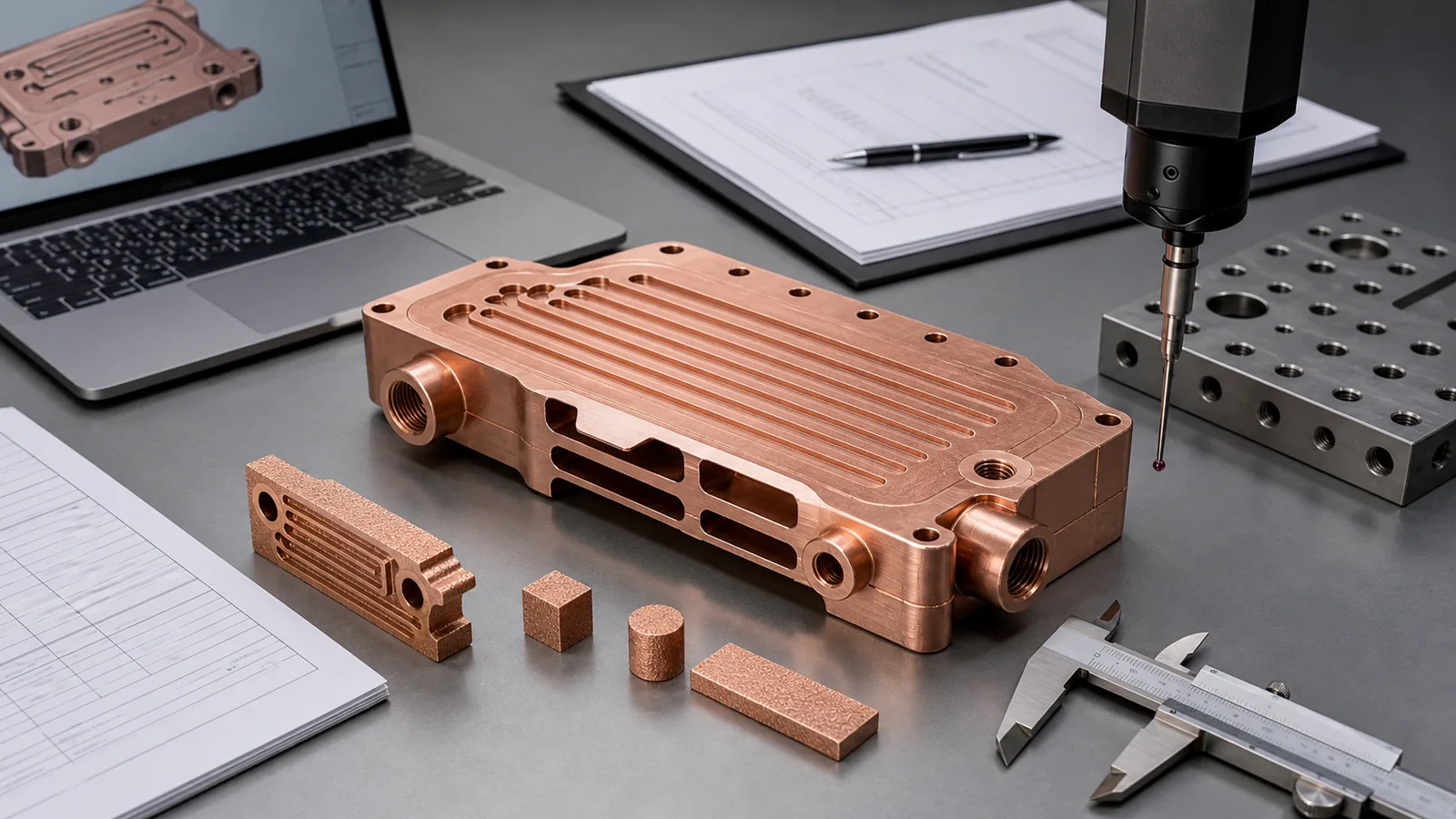
The cost of a copper 3D printing project is rarely controlled by the printed shape alone. The quote is shaped by material route, build time, support strategy, powder removal, CNC finishing, heat treatment, inspection, pressure or leak testing, and the risk carried by missing RFQ information. A low price for only the printed body is not comparable to a finished, cleaned, machined, and accepted copper component.
Image note: the cover and workshop illustrations are AI-generated concepts, not photographs of a quoted job or evidence of production capability.
The most useful cost question is not “How much per gram?”
For copper additive manufacturing, that question is usually too small. A 120 g printed coupon, a 120 g internal-channel cold plate, and a 120 g RF cavity can have completely different quotation routes. The mass may be similar. The cost drivers are not.
Work around the print can change the total substantially: process setup, support removal, machining, internal cleaning, testing, and documentation. There is no defensible universal percentage split between printing and finishing. Ask for the scope behind the price, not a percentage borrowed from a different part.
That is not a reason to avoid copper AM. It is a reason to quote it correctly.
Compare Quotes on the Same Delivered-Part Basis
Before comparing unit prices, make each supplier answer the same three questions: which revision is priced, how many accepted finished parts will be delivered, and which operations and records are included? A budget estimate with unresolved interfaces should remain an estimate until the assumptions are closed.
This worksheet is an RFQ comparison aid, not a price list or a mandatory accounting format. Mark each line included, excluded, or open, and record the quoted amount only where the supplier provides it.
| Cost bucket | What to reconcile between quotes | Repeat-order question |
|---|---|---|
| One-time engineering | DFM changes, build preparation, machining programs, fixture design, first-article planning | What can be reused for the same released revision, and who retains the files and fixtures? |
| Lot-level setup | Build setup, powder handling, machining setup, cleaning or test setup | Does each order trigger a new setup, even when the unit quantity is unchanged? |
| Recurring finished part | Material, printing, support removal, agreed thermal processing, machining and cleaning | Is this a price per accepted delivered part or only per attempted print? |
| Acceptance and records | Per-part checks versus lot sampling, destructive coupons, external inspection, reports | Which checks repeat each lot and which require a new qualification? |
| Delivery and exclusions | Protection, packaging, shipping scope, currency, quote validity and explicitly excluded work | Are these included in the unit price or separate line items? |
Use one reconciled total for the agreed order: one-time work + lot charges + accepted quantity multiplied by recurring part price + separately priced acceptance and delivery. Do not add an operation twice if it is already included in a package price. If yield risk, replacement of rejected pieces, or rework responsibility is unresolved, record it as an open commercial condition; do not invent a scrap percentage to make quotes look comparable.
NIST’s 2014 report on AM cost effectiveness examines when AM may be economical and opportunities to reduce cost. It is background for route comparison, not evidence of today’s copper prices or a COPPER 3DP quotation. The worksheet above is our practical synthesis for reviewing a finished-part RFQ.
Cost Driver 1: Why the Part Is Being Printed
The first cost driver is strategic: does additive manufacturing remove a real constraint?
Copper 3D printing is easier to justify when the part needs internal cooling channels, integrated manifolds, fewer brazed joints, compact RF or vacuum geometry, a three-dimensional conductor, or low-volume design iteration. It is harder to justify when the part is a simple copper block, plate, heat spreader, or busbar with accessible machined features.
If the only requirement is a flat copper shape with holes, CNC machining may give a cleaner cost structure. If the design needs a curved coolant path, a monolithic pressure boundary, or a manifold that would otherwise require plugs and brazed covers, copper AM can compete because it reduces assembly risk.
For route selection, start with When Copper 3D Printing Is Better Than CNC Machining. Cost only makes sense after the route has a reason.
Cost Driver 2: Build Time and Machine Occupancy
Laser powder bed fusion is priced partly by machine time. For copper, that machine time is sensitive to layer thickness, part height, build area, support volume, recoating conditions, and parameter route.
A thinner layer increases the number of layers for the same build height; total cycle time also depends on exposure, recoating, preparation, and the chosen platform. A published material build rate is not the same as the finished-part throughput. Ask which process route and post-processing operations the estimate assumes.
The build quote is usually affected by:
- Part height in the build direction.
- Number of layers.
- Cross-sectional area per layer.
- Support volume and support density.
- Machine platform and laser route.
- Powder handling and inert atmosphere requirements.
- Whether the build can share space with other compatible jobs.
A 25 mm tall part may be cheaper to build than the same envelope rotated to 80 mm height, but orientation is not only a cost choice. It also changes supports, distortion, surface quality, channel cleaning, and machining stock. A lower build price that creates a later finishing problem is not a real saving.
Cost Driver 3: Copper Process Difficulty
Copper’s optical and thermal properties make process selection important. Whether a particular copper route costs more than another alloy or manufacturing method depends on the actual platform, geometry, quantity, and delivered scope.
Copper conducts heat away from the melt zone quickly and reflects common laser wavelengths strongly. NIST research published in 2026 on LPBF of highly reflective metals describes excessive energy losses for metals such as copper and aluminum, while also showing that process optimization can improve absorption behavior. The practical quotation point is simple: copper is not stainless steel with a different color.
This process difficulty can affect cost through:
- Parameter development or validated parameter selection.
- Higher sensitivity to geometry and orientation.
- Density and defect-risk review.
- More conservative first-article planning.
- Additional coupons for conductivity, hardness, or density review.
- Possible heat treatment when material properties depend on it.
Modern green-laser and optimized infrared LPBF routes have improved copper capability. That does not remove the need to price the process route honestly, especially when the part is a pressure boundary, RF surface, thermal interface, or high-current conductor.
For design-side risk, see Design Rules for Copper Laser Powder Bed Fusion Parts.
Cost Driver 4: Material Route, Not Just Material Name
“Copper” is not enough information for a quote.
Pure copper, CuCrZr, and CuCr1Zr can all be valid, but they do not create the same cost structure. Pure copper is usually reviewed when thermal or electrical conductivity dominates and mechanical loads are controlled. CuCrZr and CuCr1Zr deserve review when threads, pressure boundaries, thin walls, repeated assembly, or heat treatment become part of the acceptance path.
Industrial suppliers position copper AM materials around conductivity-driven applications. EOS describes copper materials around thermal and electrical conductivity, heat exchangers, electronics, power electronics, and coils. 3D Systems presents CuCr1Zr(A) as a high-conductivity, high-strength copper alloy for applications such as heat exchangers, electrical components, and induction coils. Those signals are useful, but the quote still depends on the finished part.
Material route can change the quote through:
- Powder cost and availability.
- Parameter set and platform availability.
- Heat treatment requirements.
- Witness coupon requirements.
- Conductivity or hardness testing.
- Documentation tied to a named alloy or customer specification.
- Scrap risk if the material route is immature for the geometry.
If the project does not require a named alloy, write “material open to review” and explain the function. That may produce a better quote than forcing pure copper into a part that actually needs thread strength or pressure integrity.
For material trade-offs, use Copper Alloy Selection for Metal 3D Printing: Pure Cu vs CuCrZr vs CuCr1Zr.
Cost Driver 5: Support Strategy and Removal Work
Supports are not free scaffolding. They consume material, machine time, and manual labor. They also decide which surfaces will need finishing.
In copper AM, support strategy affects cost in at least four ways:
- More support volume increases build time and powder use.
- Support contact can damage surfaces that later need flatness or sealing.
- Manual support removal may be slow around ports, fins, or channel openings.
- Support scars may require CNC cleanup or redesign.
The lowest-cost orientation is not always the best orientation. If rotating the part reduces supports but places rough surfaces on an O-ring land, the quote may move cost from printing to machining. If orientation helps machining but traps powder in a long channel, the cost moves to cleaning and inspection.
A good RFQ should identify surfaces that must not carry support scars:
- Thermal contact faces.
- Sealing lands.
- RF or microwave surfaces.
- Electrical contact pads.
- Datum pads.
- Threaded port seats.
That information lets the supplier price support and finishing together instead of guessing.
Cost Driver 6: Internal Channels and Powder Removal
Internal channels are one of the strongest reasons to use copper additive manufacturing. They are also one of the strongest cost drivers.
A channel network changes the quote when it has small passages, long enclosed paths, blind pockets, many branches, poor flushing access, or pressure requirements. A 1.0 mm passage and a 2.0 mm passage may look close in CAD, but they can be very different for powder removal, flow testing, and CT review. A dead-end volume may be acceptable in a cosmetic model and unacceptable in a fluid component.
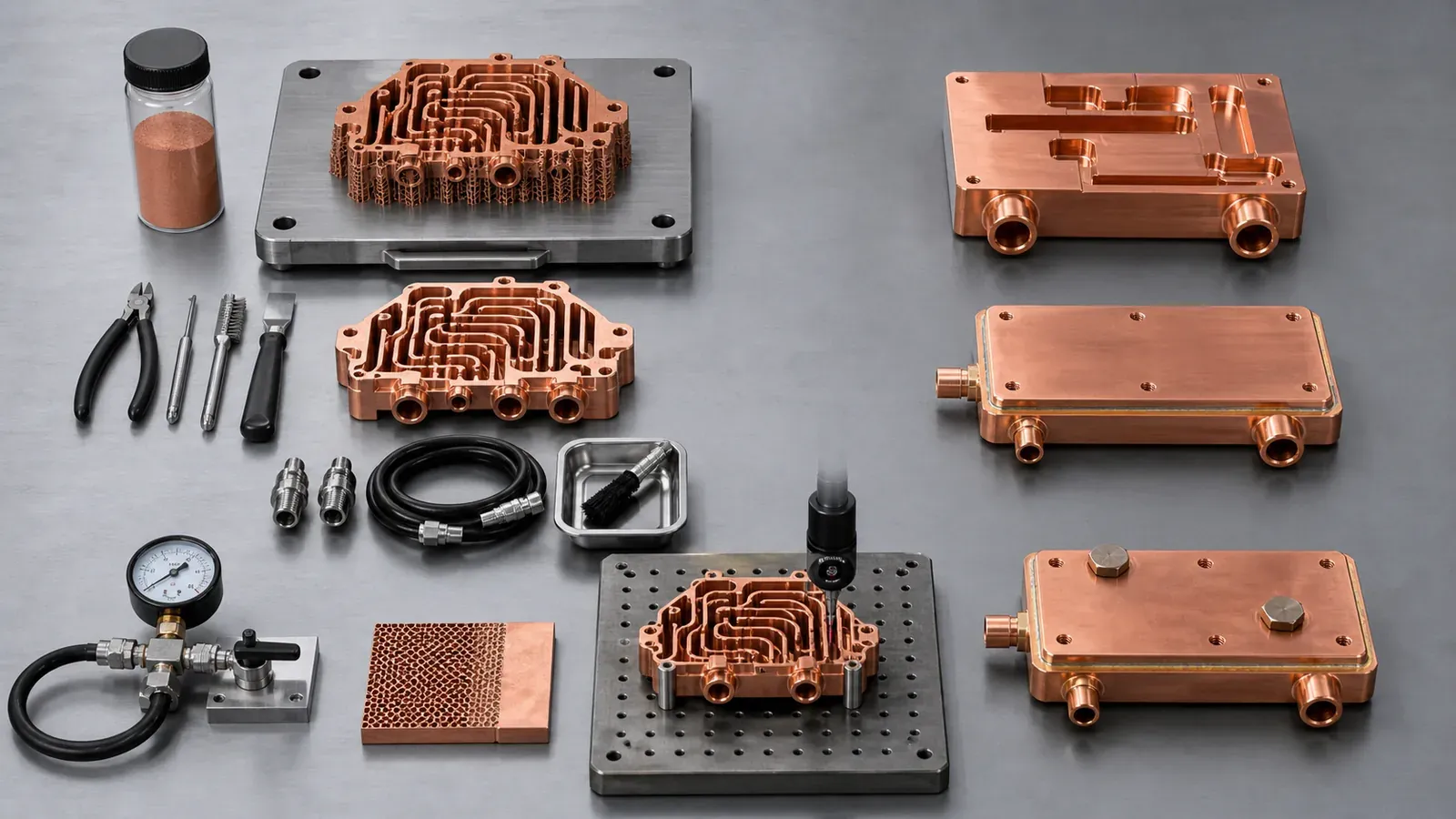
Figure 2. The expensive part of an internal-channel copper AM project is often the route after printing: support removal, cleaning, machining, pressure or flow testing, and acceptance evidence.
Channel-related cost usually comes from:
- Section review before quoting.
- Build orientation chosen around powder evacuation.
- Cleaning access features or temporary openings.
- Flushing, ultrasonic cleaning, drying, or borescope review.
- Flow testing or pressure-drop measurement.
- Leak or proof-pressure testing.
- CT inspection when the risk justifies it.
The best way to control this cost is not to ask for the smallest possible channel. It is to design channels that can be printed, cleaned, and verified. For more detail, see Copper AM Cleaning and Powder Removal for Internal Channels and 3D Printed Copper Heat Exchangers: Design Benefits and Manufacturing Limits.
Cost Driver 7: CNC Finishing After Printing
Copper AM rarely replaces CNC machining completely.
The printed body can create the internal geometry and near-net form. Functional surfaces still often need machining. This includes sealing lands, O-ring grooves, threaded ports, flat thermal faces, electrical contact pads, RF surfaces, datum pads, tube interfaces, and mounting faces.
Finishing cost depends on:
| Finished feature | Why it changes cost | Better RFQ input |
|---|---|---|
| Thermal face | Needs flatness and roughness control | Flatness target, roughness target, heat-source area |
| O-ring groove | Needs dimensional control and surface condition | Groove size, seal type, compression assumption |
| Threaded port | Needs torque and sealing reliability | Thread standard, depth, fitting type, pressure |
| Electrical pad | Needs contact resistance control | Contact area, plating, roughness, current |
| RF surface | Needs geometry and surface finish control | Frequency band, critical faces, plating requirement |
| Datum system | Controls inspection and machining setup | Datum scheme and critical dimensions |
One cost risk is sending a model at finished size without identifying surfaces that must be machined. Adding stock later can change the blank geometry, channel-to-surface relationship, supports, and build time. Agree the allowance against the finished model and available wall thickness; this guide does not prescribe a universal stock value.
Cost Driver 8: Inspection and Acceptance Scope
Inspection is not paperwork after the job. It is part of the manufacturing route.
A quote for a printed copper prototype with visual inspection is not comparable to a quote for a finished cold plate with CMM report, pressure hold, leak test, flow check, and cleanliness packaging. Both can be legitimate. They are different deliverables.
Acceptance scope may include:
- CMM report for machined datums and hole positions.
- Surface roughness measurement.
- Flatness or parallelism report.
- Leak test or pressure hold.
- Flow rate or pressure-drop test.
- CT inspection for internal geometry.
- Conductivity or hardness testing.
- Witness coupons processed with the part.
- Cleaning record or packaging requirement.
For a pressure-boundary project, fixture design and test readiness belong in the quote. A test must have an agreed method, acceptance criterion, and fixture boundary; its duration cannot be inferred from the size of the part alone. For scheduling dependencies, reuse the copper AM lead-time planning guide.
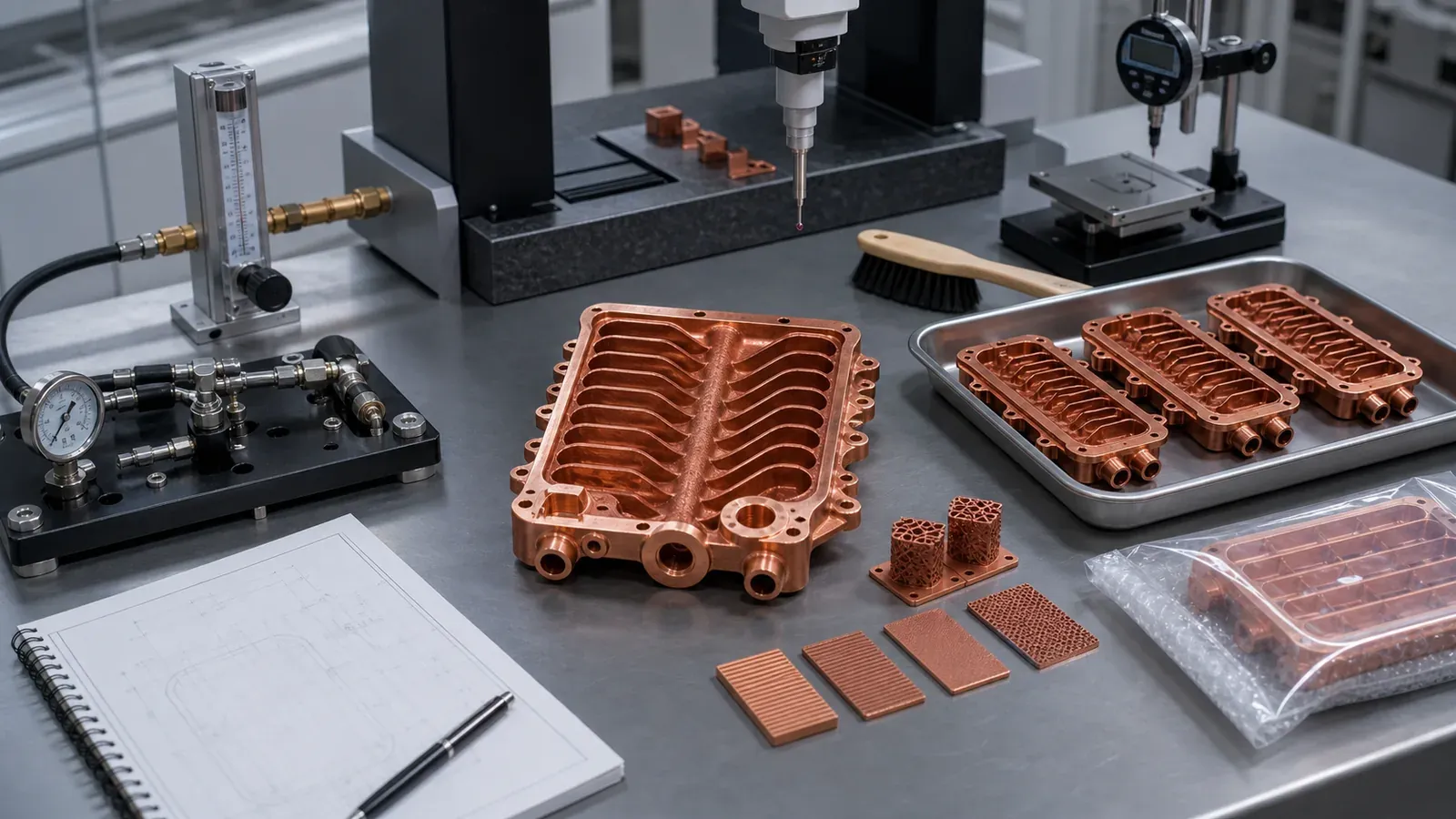
Figure 3. Illustrative acceptance-planning scene, not a project test record. Include the agreed inspection and test scope when comparing finished-part costs.
Cost Driver 9: Quantity, Batch Strategy, and Development Stage
Quantity changes the cost model, but not always in the way buyers expect.
For a small prototype order, engineering and setup can dominate the price per part. A stable repeat batch may share preparation, compatible build space, and fixtures, but there is no universal quantity at which the price drops or CNC becomes cheaper. Request separate prices for the actual prototype, first-article, and repeat-order quantities rather than extrapolating one unit price.
The development stage also matters:
| Stage | Typical cost logic | Quote expectation |
|---|---|---|
| Concept review | Geometry and route are still open | Conditional estimate or DFM feedback |
| Prototype | Learning matters more than unit cost | Limited batch, stated assumptions |
| First article | Acceptance route must be proven | Full finishing and inspection scope |
| Pilot batch | Repeatability starts to matter | Fixture and batch inspection planning |
| Production | Cost stability matters | Defined process route and change control |
Do not ask a prototype quote to behave like a mature production quote. If the geometry is likely to change after the first test, say so. A supplier may recommend a lighter inspection route for the first print and a stronger validation route for the next build.
Cost Driver 10: RFQ Completeness
Missing information is a cost driver.
When an RFQ omits pressure, flow, current, material state, critical surfaces, inspection, or quantity stage, the supplier has three options. They can ask questions, quote with assumptions, or add risk allowance. None of those options is as clean as receiving the right data at the start.
The most expensive missing items are usually:
- No function statement.
- No channel section views.
- No working pressure or proof pressure for fluid parts.
- No current, duty cycle, or contact surface definition for electrical parts.
- No RF band or critical surface definition for RF parts.
- No material preference or property target.
- No machining stock on critical faces.
- No inspection or acceptance method.
- No development stage or target quantity.
Use the Engineering Checklist for Copper 3D Printed Part Quotation before requesting a formal price. The goal is not to make the first email perfect. The goal is to avoid hiding the expensive parts of the quote.
A Practical Copper AM Cost Breakdown
Use this table to read a copper AM quote more intelligently.
| Cost item | Low-risk condition | Higher-cost condition |
|---|---|---|
| Build preparation | Simple orientation, few supports | Complex supports, distortion risk, channels |
| Material | Common qualified route | Special alloy, coupons, strict documentation |
| Machine time | Low height, shared build possible | Tall build, dense cross-section, dedicated run |
| Support removal | External, accessible supports | Supports near ports, fins, channels, critical faces |
| CNC finishing | Few accessible faces | Many datums, ports, O-ring grooves, RF surfaces |
| Cleaning | Open geometry | Long internal channels or cleanliness requirement |
| Heat treatment | Not required or standard | Property-driven route with coupons |
| Inspection | Dimensional check only | CMM, leak, flow, CT, conductivity, hardness |
| Documentation | Basic delivery | First-article report, material route, test records |
| Schedule | Flexible | Rush timing, fixed test date, third-party inspection |
This table also helps procurement compare quotes. If one supplier includes machining, pressure testing, and CMM while another only prices the printed body, the lower number may not be the lower project cost.
Worked Scope Comparison: Printed Blank or Accepted Cold Plate?
This is an illustrative comparison, not a customer case or a measured saving. Suppose two proposals refer to the same cold plate drawing, but Proposal A lists a printed blank while Proposal B lists a finished component.
| Open question | Proposal A: blank scope | Proposal B: finished scope |
|---|---|---|
| Thermal face and ports | Ask who supplies the machining, stock plan, and final inspection | Confirm the exact drawing features covered, not just the word “machined” |
| Internal channels | Confirm depowdering responsibility and what evidence is delivered | Confirm cleaning, flow and leak scope, methods, and acceptance criteria |
| Quantity | Confirm whether the count means printed blanks or accepted parts | Confirm whether coupons, destructive samples, and replacements affect delivery quantity |
| Final release | Price or explicitly exclude the downstream work still needed | Check whether reports and agreed packaging are included |
Neither label proves a lower total cost. If Proposal A leaves mandatory finishing unpriced, record the total as incomplete. Ask for the missing scope before ranking it against Proposal B or a CNC-and-braze alternative.
Build a comparable quotation record
Download the quote-scope comparison sheet (CSV). Use a separate copy for each part revision and record the quote IDs. Align the currency, number of accepted parts, delivered material state and commercial terms before comparing totals.
Separate one-time engineering and fixtures from recurring production. A mandatory operation with no price is an unresolved cost, not zero. If one supplier includes it inside a bundle, mark it “included” and reference the bundle instead of counting it twice. Record freight and import exclusions explicitly. Compare an initial order and an unchanged repeat order separately; fixture reuse and repeat pricing need confirmation.
The sheet contains no assumed copper price, hourly rate, yield or saving. Its purpose is to expose missing scope before a purchasing decision. A project sketch or CAD file is enough to start a quotation review; unknown details can remain open until the formal scope is agreed.
What Must Be Repriced After a Design Change?
A repeat order is not automatically the same job when the drawing, material state, or acceptance scope changes. Send the revision difference as well as the new file, then ask for a changed/unchanged statement against the earlier quote.
| Change | Cost assumptions to reopen |
|---|---|
| Channel, wall, or port geometry | Build orientation, cleaning access, machining stock, inspection access and test fixtures |
| Material or delivered heat-treatment state | Qualified route, processing, coupons and required property evidence |
| Surface or tolerance requirement | Tool access, fixture rigidity, finishing sequence and measurement method |
| Quantity or delivery split | Build packing, number of setups, sampling and packaging |
| New acceptance requirement | Test method, fixture, external laboratory scope, records and rejection/rework conditions |
Ask which one-time costs remain reusable and which must be repeated. Record who approves the revised scope before production. This avoids assuming that an earlier prototype price covers a later production release.
How to Reduce Cost Without Weakening the Part
Cost reduction in copper AM should remove unnecessary work, not necessary controls.
Start with these actions:
- Open the manufacturing route if CNC, brazing, or hybrid processing may be better.
- State whether pure Cu, CuCrZr, or CuCr1Zr is required or only preferred.
- Increase channel access where cleaning is the real risk.
- Mark only the surfaces that truly need machining.
- Avoid over-tight tolerances on nonfunctional faces.
- Separate prototype inspection from production acceptance if the first part is for learning.
- Allow supplier review of build orientation and support placement.
- Consolidate batch requirements when parts are stable.
- Define leak, pressure, flow, or CMM acceptance before quotation.
Do not reduce cost by removing the test that proves the function. If a copper cold plate must hold pressure, removing the pressure test only moves the risk to the buyer. If an RF component depends on an internal surface, ignoring finish requirements does not make the surface acceptable.
For application-specific cost control, see Copper 3D Printing for Microchannel Cold Plates in Thermal Management, Copper 3D Printed Heat Sinks for Power Electronics Cooling, and Copper AM Parts for Semiconductor Equipment.
FAQ
What is the biggest cost driver in copper 3D printing?
For simple parts, machine time and material route may dominate. For functional thermal, fluid, RF, or electrical parts, the largest cost driver is often the finished scope: CNC machining, cleaning, pressure or leak testing, inspection, and documentation.
Is copper 3D printing priced by weight?
Weight matters, but it is not enough. A lightweight part with difficult internal channels can cost more than a heavier simple part because cleaning, supports, inspection, and risk drive the route.
Why does a copper AM quote include CNC machining?
Copper AM creates near-net geometry and internal features, but functional surfaces often need machining. Sealing lands, flat thermal faces, ports, threads, datum pads, RF surfaces, and electrical contact pads should be treated as finished features.
Can we lower cost by removing CT inspection?
Sometimes. CT should match the failure mode. If flow, pressure, and leak testing give enough evidence for the part, CT may not be needed. If hidden geometry is the acceptance risk, removing CT may only hide the problem. Define the acceptance logic before deleting inspection steps.
What information helps produce a better copper AM quote?
Send CAD, drawing, quantity, material preference, function, operating pressure or current, thermal requirement, critical surfaces, post-processing expectations, and inspection requirements. If some values are unknown, state the assumptions rather than leaving them hidden.
Verdict: Price the Finished Copper Component
Copper 3D printing cost should be evaluated as a manufacturing route, not a printed-object price.
The useful cost ledger is: why print the part, which material route is needed, how long the build takes, where supports go, how powder leaves internal channels, which faces need CNC finishing, what tests prove acceptance, and how much RFQ uncertainty remains.
If the part is simple and accessible, conventional machining may be the better cost route. If the part needs internal channels, integrated manifolds, fewer joints, compact thermal paths, or low-volume iteration, copper AM deserves review. The quote should make every major cost driver visible before the purchase order, not after the first article fails.
Send CAD, drawing, quantity, material preference, operating requirements, critical surfaces, and acceptance criteria to info@szcomo.com, or use the RFQ guidance page to organize the package.
Related reading: Engineering Checklist for Copper 3D Printed Part Quotation, Copper 3D Printing Lead-Time Planning, Design Rules for Copper Laser Powder Bed Fusion Parts, When Copper 3D Printing Is Better Than CNC Machining, and Copper AM Cleaning and Powder Removal for Internal Channels.
Copper AM quotation
Is copper AM a fit for your part?
Describe the part, its job, and the question holding up your decision. Add quantity and critical requirements if known; CAD can follow.
NDA available on request. We reply within 2 business days.
Before you submit: Copper AM capabilities and review scope.
