
Copper Alloy Selection for Metal 3D Printing: Pure Cu vs CuCrZr vs CuCr1Zr
Shortlist pure Cu, CuCrZr and CuCr1Zr by part duty, exact designation and delivered state. Check whether supplier property data can support the same finished part.
Working on a copper part? Start a project review — share a brief; CAD can follow.
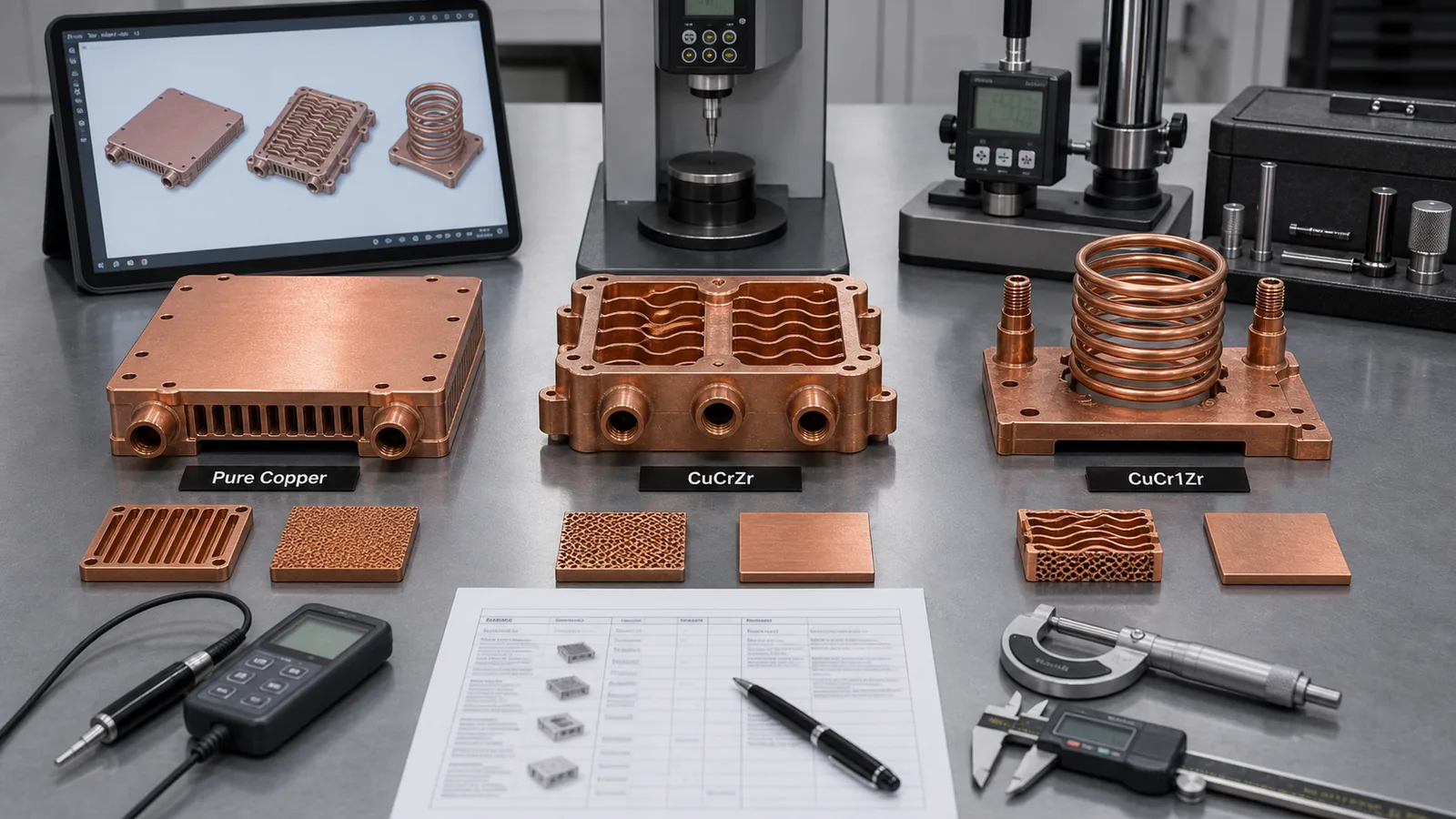
Start with the part’s required function and acceptance limits, then shortlist a material-and-process route. Pure copper is worth reviewing when conductivity dominates. A heat-treated copper-chromium-zirconium route is worth reviewing when conductivity must be balanced with mechanical requirements. Neither the alloy name nor a supplier’s typical property value is finished-part acceptance evidence.
Illustration note: the existing cover and figures are AI-generated concepts, not photographs of our parts, equipment, comparative trials or test results. Different illustrated shapes do not establish which alloy is suitable.
This guide is the selection step: deciding which candidate routes deserve a quotation or further testing. It is not a substitute for the final material specification. If both strength and conductivity are contractual requirements, use the linked material specification guide after the shortlist is agreed.
First Gate: What Property Must Not Fail?
A copper component can be unacceptable because it cannot transfer enough heat or current. It can also be unacceptable because a contact face moves, a threaded port is damaged, a passage cannot be cleaned, or the delivered material state is undocumented.
Describe the function before choosing a powder:
| Dominant requirement | Candidate review | What can still change the decision |
|---|---|---|
| Heat or current transfer with controlled mechanical loads | Pure Cu and a documented conductivity route | Contact resistance, actual thermal duty, flatness and final process state |
| Conductivity plus mechanical loading | Pure Cu and heat-treated CuCrZr-family alternatives | Required strength at service temperature, loading, geometry and available evidence |
| Fluid pressure boundary | Material and wall/port design together | Defects, channel access, pressure differential, seals and the agreed leak/proof tests |
| RF or high-frequency surface | Material, surface and finishing route together | Frequency, internal roughness, plating, dimensional accuracy and test boundary |
| Drawing specifies a material | The specified designation and state | An alternative requires documented customer approval |
| Early prototype with unresolved requirements | Open material review | Record assumptions and the information needed to close them |
Pressure alone does not select an alloy. A stronger coupon does not establish that a printed channel wall is leak-tight. Keep material properties, manufacturing defects and assembly performance as separate questions.
CuCrZr and CuCr1Zr: Clarify Names Before Comparing Properties
Do not assume that these names describe two fundamentally different alloy families, or that CuCr1Zr automatically means a more highly qualified product.
There is a useful public example. The EOS CuCrZr product page identifies a composition complying with C18150 and CW106C. The 3D Systems CuCr1Zr(A) page also identifies C18150 and CW106C, while naming its own DMP machine route. This illustrates overlapping designations, not equivalence of every powder, process, heat treatment or finished part sold under these names.
For either designation, ask:
- What exact material specification, revision and composition limits apply?
- Is the name a general family description, a standard designation or a supplier product name?
- Which machine, parameter set and delivered material state support the quoted properties?
- Does the drawing permit the proposed route, or is substitution approval still open?
The same documentation discipline applies to pure copper. A purity label alone does not define the printed condition, conductivity acceptance or permitted process changes.
If a drawing specifically requires CuCr1Zr, retain that callout until the authorized engineering/quality owner approves an alternative. See CuCr1Zr designation and substitution control for that narrower decision.
Pure Cu: Review the Conductivity Benefit at Part Level
Pure copper is a useful candidate for broad heat spreaders, conductors and thermal or RF components where conductivity is a dominant requirement. That is a starting hypothesis, not an automatic winner over every copper-alloy AM route.
Ask whether the benefit survives the rest of the design:
- Is the limiting resistance in the bulk metal, a contact interface, a joint or the cooling system?
- Can the finished thermal/contact face meet its requirement after processing and assembly?
- Are the actual thread loads, clamp loads and service temperatures acceptable for the proposed state?
- Are channels accessible for powder removal, cleaning and verification?
- Is there a controlled manufacturing route for this geometry rather than only a favorable coupon result?
Use the pure copper manufacturing guide for process feasibility. For a cooling component, the pure copper versus CuCrZr heat-transfer comparison separates conductivity sensitivity from a finished-system comparison.
CuCrZr-Family Routes: Evaluate the Delivered State
Copper-chromium-zirconium routes are candidates when thermal or electrical performance must coexist with mechanical requirements. EOS explicitly ties the useful combination of properties in its CuCrZr route to heat treatment on the product page cited above. Do not compare an as-built value for one route with a heat-treated value for another and label the difference an alloy advantage.
A candidate route should identify the sequence relevant to the finished part: printing, any stress relief or other heat treatment, support removal, machining and subsequent thermal exposure. Which operations are required, and their order, depend on the qualified route; this article does not prescribe a universal heat-treatment recipe.
Typical review questions include:
- Are strength and conductivity data available for the same final state, rather than separate favorable conditions?
- Is the service temperature inside the evidence supporting the proposed state?
- Will later machining, joining, coating or heating change the accepted condition or dimensions?
- Can functional faces, threads and sealing lands be inspected after the operations that may affect them?
- What evidence is needed beyond a witness coupon?
See the strength-led CuCrZr decision guide when threads, clamp loads or pressure-wall design drive the shortlist.
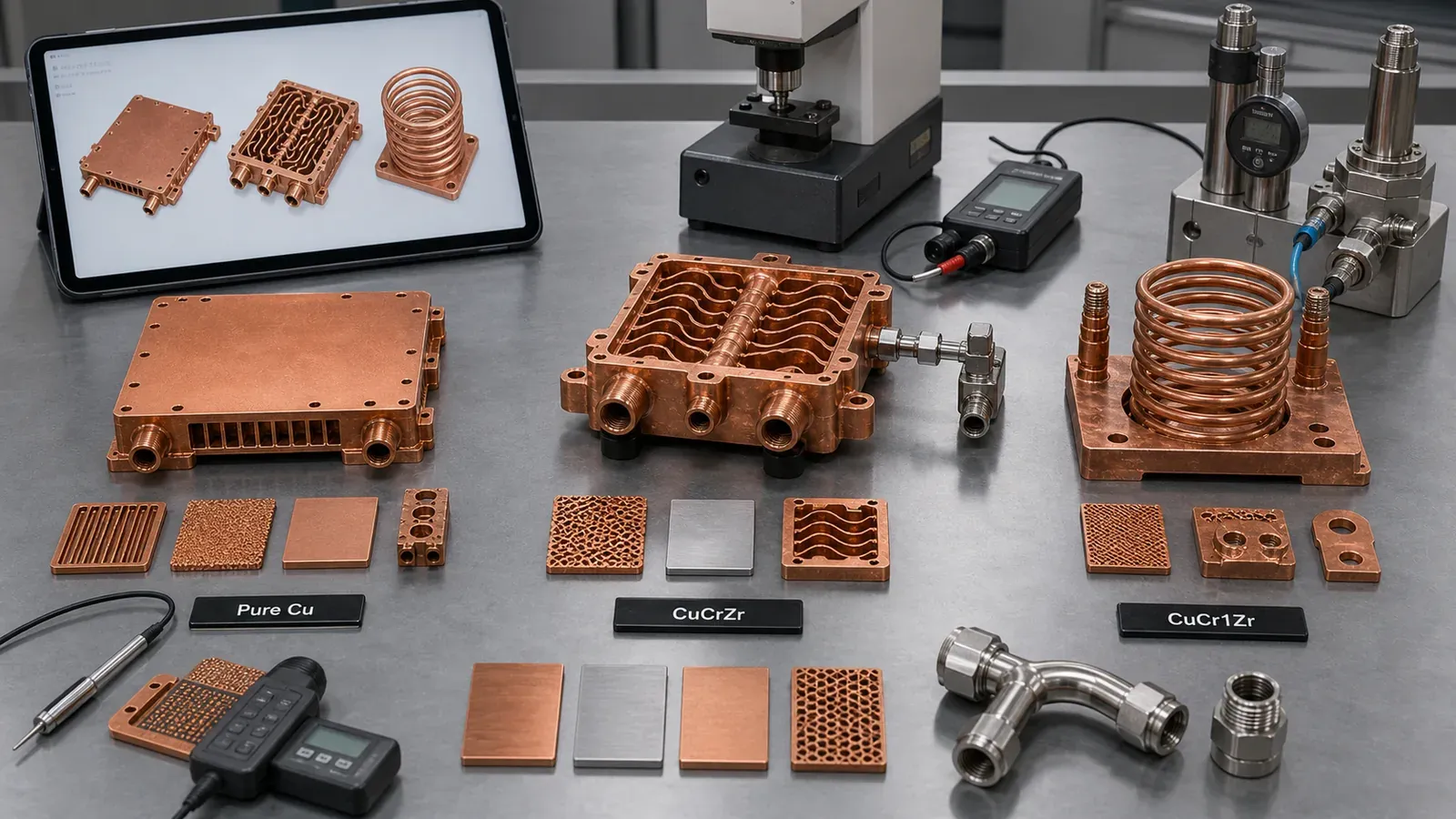
Different geometries and specimen appearances cannot establish a material ranking. Compare documented candidate routes against the same part requirements.
Can Two Supplier Data Sheets Actually Be Compared?
Before copying property values into a purchasing comparison, check their basis. Missing evidence should be marked not yet comparable, not silently treated as a passing value.
| Check | What to record for each candidate | Why the comparison may remain open |
|---|---|---|
| Identity | Product name, material specification and document revision | Similar names do not prove identical chemistry or an approved substitution |
| Manufacturing route | Machine/process identification and relevant parameter qualification | Data from another platform or build condition may not represent the quoted route |
| Delivered state | State associated with each property and the planned final process sequence | Strength from one state and conductivity from another are not one deliverable |
| Specimen and method | Test method, temperature, orientation and specimen condition where relevant | Different measurement bases can make a numerical ranking misleading |
| Type of value | Typical result, reported range or agreed minimum acceptance limit | A typical data-sheet result is not a guaranteed minimum |
| Transfer to the part | Geometry, section, build location and post-processing relevance | A coupon does not verify internal passage cleanliness, sealing or local dimensions |
| Remaining decision | Accepted evidence, open requirement and person responsible for closure | An unresolved requirement must not disappear when the quote is issued |
Electrical conductivity in % IACS and thermal conductivity in W/m-K are not interchangeable acceptance results. If thermal performance is the requirement, identify the thermal-property source or an agreed correlation and its limits; do not silently substitute an electrical test.
This comparison is an evidence screen, not a requirement to commission every possible test. The acceptance plan should be proportionate to the function, project stage and consequences of failure.
Worked Selection Example: Close the Evidence Gap Before Naming a Winner
The following is a hypothetical procurement exercise, not a customer case or a reported COPPER 3DP result.
Suppose a cooling block has a clamped contact face, two fluid ports and an unfixed material callout. Candidate A offers pure copper with a favorable typical conductivity figure. Candidate B offers a heat-treated CuCrZr-family route with documented conductivity and mechanical data.
That is not enough to award the part to either route:
- Establish the same duty. Confirm the thermal limit, loading, pressure boundary and critical finished surfaces. An unknown clamp load remains an open requirement for both candidates.
- Check the data basis. Ask A for its delivered-state and mechanical evidence; ask B whether the documented state and manufacturing route match the quotation.
- Review the real geometry. Both must address channels, cleaning access, wall/port design and finishing. Neither data sheet proves the part can be cleaned or sealed.
- Close or label the decision. If evidence supports the duty, carry that candidate into the quotation. If a mandatory requirement remains unsupported, identify the needed design change, analysis or test before release.
The outcome may be pure Cu, a CuCrZr-family route, a redesigned component, or a conventional manufacturing route. Choosing a more complex alloy is not itself evidence that risk has been resolved.
Start a Review Without Completing a Full Specification
For an initial material and manufacturing review, send what is already available: the part’s function, CAD or a sketch, the main operating constraints, any mandatory material callout, and the project stage. State “material open to review” if that is the real position. Unknown fields can remain open.
Before a firm scope and acceptance plan are agreed, the review may need:
- Critical dimensions, datums, surfaces and the proposed finishing boundary.
- Heat load, current, RF duty or other functional requirements relevant to the part.
- Mechanical loading and service temperature; pressure and leak criteria for fluid or vacuum boundaries.
- Required delivered properties, their methods and whether a value is a target or an acceptance limit.
- Quantity, intended development stage and requested delivery timing.
Do not impose every fluid, RF and electrical test on every part. Use the quotation checklist for the applicable scope, and the material specification guide when the shortlist becomes a contractual requirement.
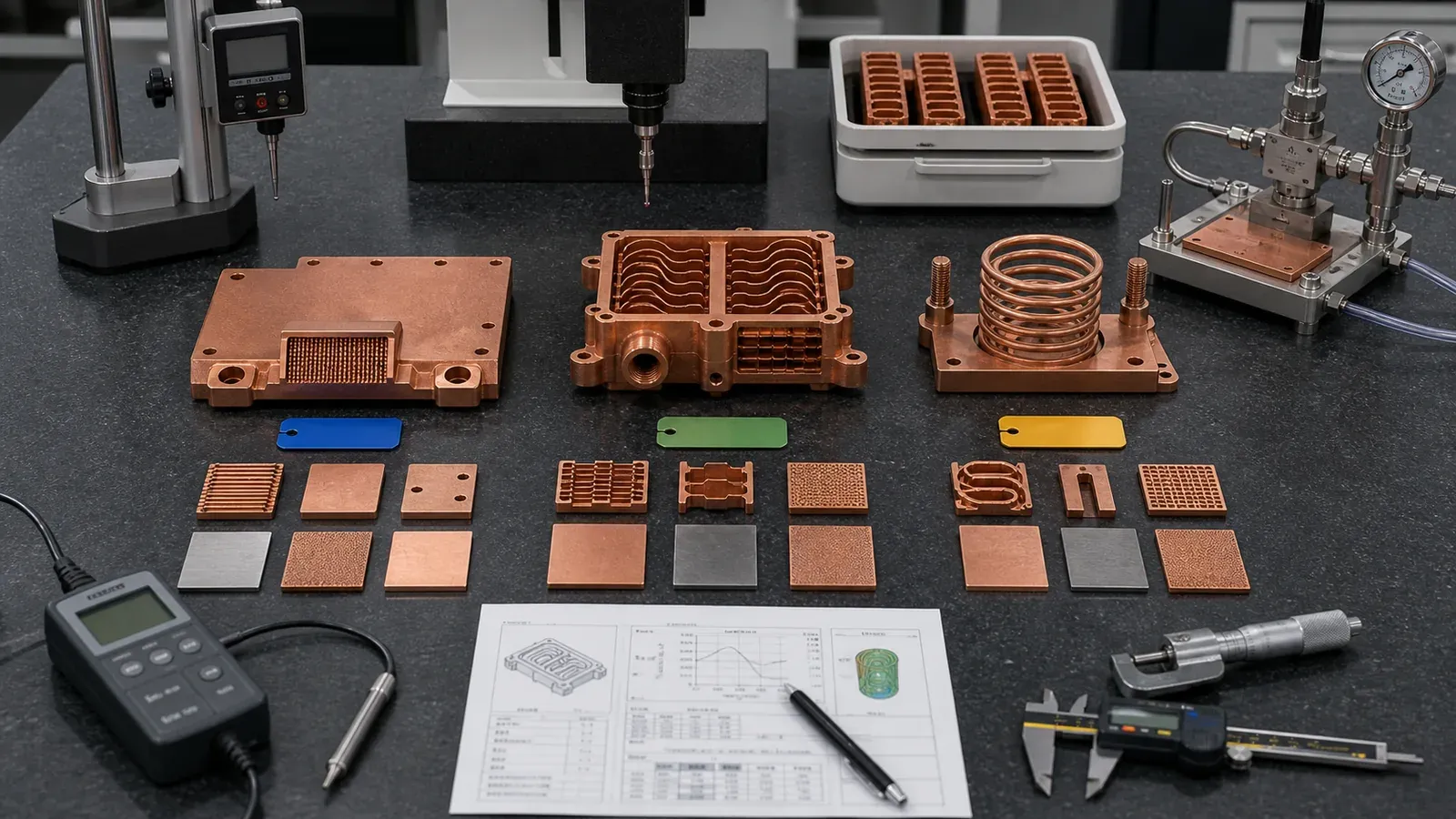
Material-state evidence and finished-part acceptance answer different questions. The pictured instruments are illustrative and do not establish available equipment or completed tests.
FAQ
Are CuCrZr and CuCr1Zr interchangeable?
Not automatically. Public supplier documentation shows overlap in designations such as C18150 and CW106C, but a shared designation does not establish identical powder, process, material state or qualification. Confirm the exact specification and obtain approval for any substitution controlled by the drawing or purchase requirements.
Is pure copper always the best conductivity choice for an AM part?
It is a useful candidate when conductivity dominates, but compare data for the proposed delivered state and relevant test conditions. Then check whether bulk conductivity materially changes the finished component’s performance. Contacts, interfaces, geometry and the cooling system may control the result.
Can we select an alloy using a supplier's typical values?
Use them to screen candidates, not as an automatic minimum guarantee. Confirm which state, process and test basis the values describe. If a minimum is mandatory, agree the acceptance method and supporting evidence with the supplier before committing to that requirement.
Do we need to choose the alloy before requesting a quote?
No. You can request a material review with the function, available geometry and known constraints. Clearly identify mandatory callouts and unresolved requirements so that a preliminary recommendation is not mistaken for a released specification.
Decision to Carry Into the RFQ
Select a documented route for a finished part, not a keyword. Pure Cu remains a candidate where its conductivity benefit is useful and the mechanical requirements can be met. A CuCrZr-family route remains a candidate where its delivered-state evidence supports the combined duty. Exact designation and substitution control matter for both.
The next step is to close the highest-risk unknown, then quote the agreed material state, manufacturing scope and acceptance evidence together. Start through the online RFQ, or send the available information to info@szcomo.com.
Copper AM quotation
Need to choose a copper material for a part?
Describe the part, operating environment, and properties that matter. State the material preference only if decided; material state and acceptance can be reviewed together.
NDA available on request. We reply within 2 business days.
Before you submit: Copper materials and delivered condition.
