
Monolithic vs Brazed Copper Cold Plates
Compare monolithic and brazed copper cold plates using leak risk, thermal cycling, inspection burden, and unit cost drivers.
Working on a copper part? Start a project review — share a brief; CAD can follow.
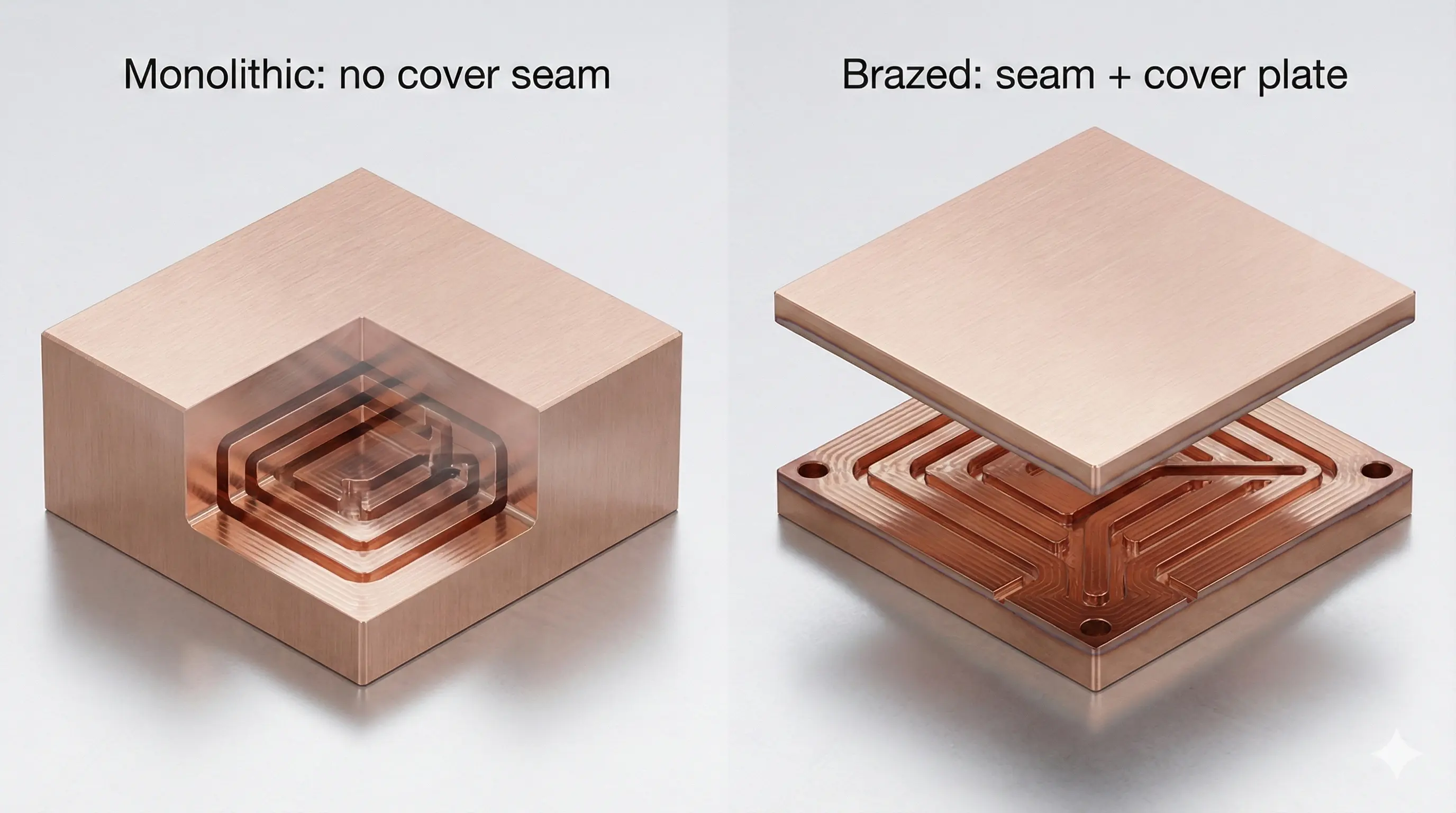
A monolithic copper cold plate can remove a cover joint from the fluid body, but it does not remove every leak path or prove a thermal advantage. Compare the actual manufacturing and closure route, the installed duty, and the evidence needed to release the finished part.
This page answers which construction to evaluate. For complete thermal development and validation, use the thermal design support page.
The cover is a concept illustration of construction choices, not a sectioned production sample or a measured comparison.
First distinguish three constructions
“Monolithic” is not a sufficiently precise manufacturing specification.
| Construction | How the fluid path is formed | What still needs qualification |
|---|---|---|
| LPBF one-piece fluid body | Internal geometry is built with the body; accessible features may be machined afterward | Powder removal, internal geometry, material state, pressure boundary, ports and seals |
| Drilled block with closures | Straight or intersecting holes are machined into stock; drilling access may require plugs or other closures | Every closure, intersection, remaining wall and connection |
| Machined channels with a brazed cover | Open channels are machined and a separate cover is joined by brazing | Joint design, joining process, distortion, internal cleanliness and finished assembly |
CNC milling of an open pocket does not by itself create an arbitrary closed internal passage. A drilled block with sealed access holes also should not be described as having no joints. The quotation and drawing should identify all permanent closures and detachable connections.
What changes when the cover joint is removed?
Removing a brazed cover removes that specific joint from the risk review. An LPBF design still has material-integrity, machining, cleaning and connection requirements. A port, an O-ring interface or an approved access closure remains part of the containment boundary.
Conversely, a brazed construction is not automatically unreliable. It may offer direct access to channel surfaces before joining and a manufacturing route appropriate to the required geometry and production volume. The decision is whether the supplier can control and verify the selected construction for this duty.
Use the port and seal design guide to list connections explicitly. Do not let the word “monolithic” remove them from the test boundary.
Compare both concepts at the same installed conditions
Keep heat-source locations, interface stack, coolant, inlet conditions, allowed pressure loss, mounting constraints and service envelope consistent. A lower simulated wall temperature at a different flow rate is not a like-for-like comparison.
| Decision factor | Question for an LPBF body | Question for a brazed assembly |
|---|---|---|
| Thermal and hydraulic architecture | Does the internal geometry solve a real routing or distribution constraint? | Can accessible channels achieve the duty with less development? |
| Manufacturing access | Can powder, supports where applicable, and processing residues be removed? | Can channels and joint surfaces be inspected and cleaned before closure? |
| Finished interfaces | What stock and datums are needed for machining ports and contact faces? | How are joining distortion and final machining accounted for? |
| Evidence | Can critical hidden features be evaluated with the selected inspection route? | How will joint quality and final containment be demonstrated? |
| Maintenance | Is the final fluid path flushable and compatible with the service strategy? | Is a permanently joined cover acceptable for cleaning or repair expectations? |
The Open Compute Project cold plate workstream organizes requirements and interface guidance for data-center cooling. Use an applicable platform document when relevant; its scope is not a universal approval of either construction.
Compare quotation scope, not an unsupported saving percentage
Request separate entries for design review, first-article development, build or machining, joining where applicable, finishing, cleaning, fixtures, inspection, testing and documentation. Distinguish one-time engineering or tooling from recurring part costs.
Ask what happens after a failed first article: who investigates, which operations must be repeated, what is recoverable, and what requires a new part? A low initial piece price is not a complete comparison if required testing or interface machining is excluded.
No fixed volume break-even or percentage saving is assumed here. Geometry, capacity, inspection scope, yield evidence and the required delivery state determine the comparison. The broader AM versus CNC guide addresses the process decision beyond cold plates.
Illustrative decision review: retain or remove the cover?
Consider a hypothetical cooling block with an obstructed port location and a mounting envelope that prevents a simple drilled route. This is a review example, not a customer result.
- Establish whether revised external plumbing solves the constraint without changing the body construction.
- Compare an open-channel-and-cover concept with an LPBF passage that routes around the obstruction.
- Check removal and inspection access before optimizing either passage.
- Price both in the same finished state, including connections, contact-face machining and acceptance.
- Continue the LPBF route only if its routing or assembly benefit justifies the extra development and verification.
If both concepts satisfy the duty and the simpler construction has clearer evidence and lower total delivery risk, there is no benefit in selecting the more complex option solely because it uses additive manufacturing.
Release the chosen construction with evidence
Agree the test boundary after relevant manufacturing and finishing steps. Define leakage, proof and flow acceptance independently; do not assume that helium testing is mandatory for every application or that one test proves all three requirements.
Use the CT and leak acceptance guide for hidden-feature evidence, and the cold plate RFQ checklist for quote inclusions and unresolved responsibilities.
Is a one-piece cold plate always more leak-resistant?
It eliminates only the joints actually removed by the design. Reliability still depends on the finished material, geometry, connections, duty and verification evidence.
Can a brazed cover be repaired or removed for service?
Do not assume it can. The joining route and product requirements determine the permitted repair or replacement strategy. Agree this before selecting the construction.
Copper AM quotation
Review a copper cold plate or cooling part
Describe the cooling problem and available space. Add a sketch or CAD, coolant, heat load, and flow or pressure limits where known; leave open requirements for review.
NDA available on request. We reply within 2 business days.
Before you submit: Custom copper cold plate service.
