
Plating and Finishing Copper AM Parts
RFQ guide for plating and finishing copper additive manufacturing parts: contact pads, RF surfaces, sealing faces, nickel, silver, gold, tin, cleaning, masking, and inspection.
Working on a copper part? Start a project review — share a brief; CAD can follow.
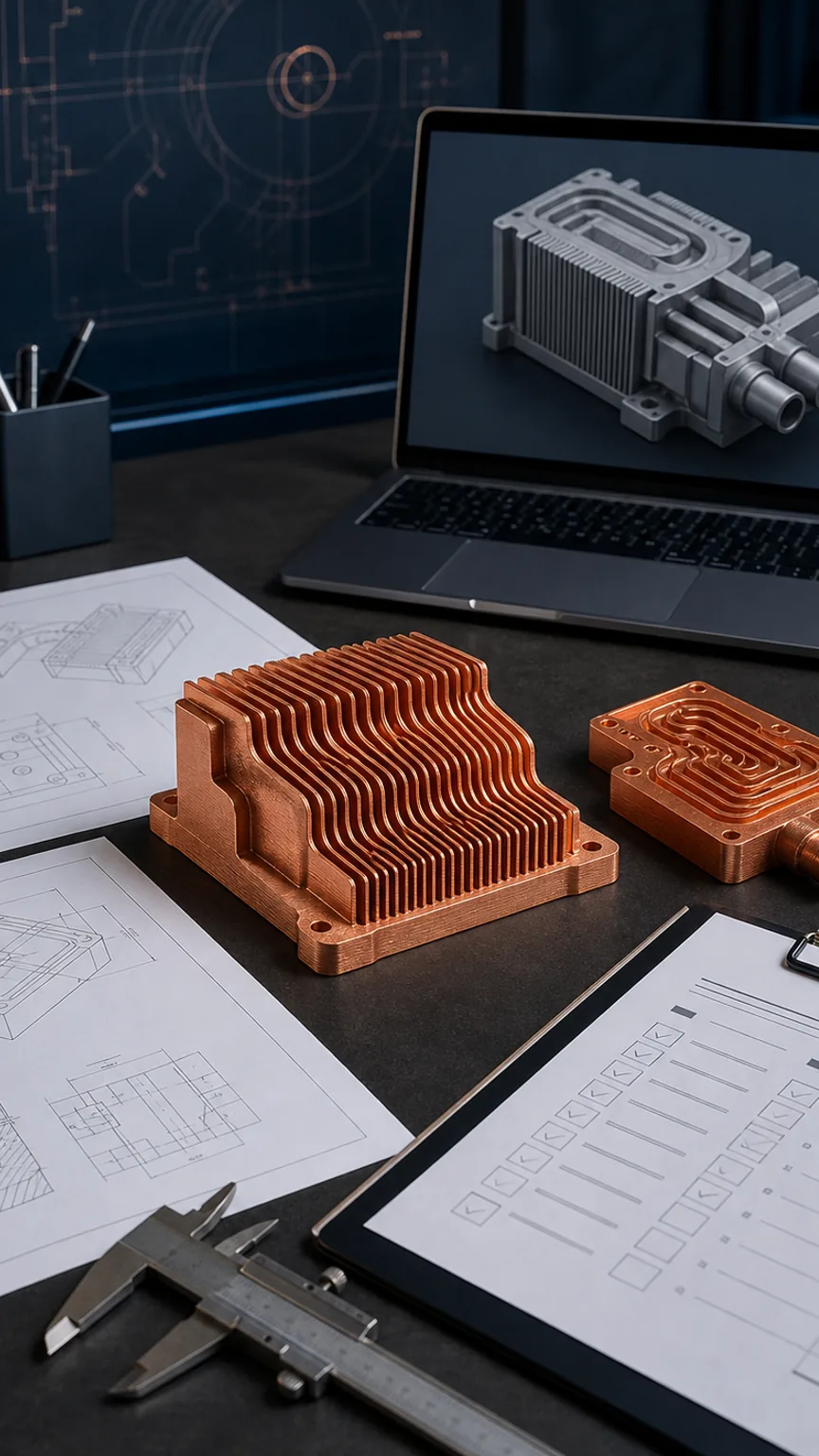
Plating and finishing should be specified as part of the copper AM manufacturing route, not added after price. The RFQ should name the surfaces that need conductivity, corrosion control, solderability, RF behavior, sealing, or wear resistance, and separate them from surfaces that can remain as-printed or only lightly cleaned.
Finishing Is A Functional Requirement
Copper additive manufacturing can produce useful geometry, but the printed part is rarely the final functional surface everywhere. A copper cold plate may need machined sealing faces. An RF part may need a defined conductive path. A current-carrying part may need flat contact pads. A vacuum or fluid part may need cleaned internal passages and protected sealing lands.
The useful first question is:
Which surfaces actually decide acceptance?
If the RFQ only says “nickel plate all over” or “polish surface,” the quote may include the wrong scope. Some surfaces need machining before plating. Some should be masked. Some internal surfaces may not be reachable. Some plating choices are driven by the mating assembly, not by the printed part itself.
Common Reasons To Plate Copper AM Parts
Plating may be reviewed for several different reasons:
- Contact resistance control on high-current contact pads.
- Solderability or bondability.
- Corrosion or oxidation control during storage or service.
- Wear resistance on repeated mating surfaces.
- RF surface performance or compatibility with existing hardware.
- Vacuum, clean handling, or process environment requirements.
- Cosmetic consistency for customer-facing hardware.
These are different use cases. A plating stack for a busbar contact pad is not automatically correct for an RF cavity, a coolant manifold, or a semiconductor equipment part.
Separate As-Printed, Machined, And Plated Surfaces
A strong drawing or RFQ marks surface classes. It does not treat the whole part as one finish.
| Surface class | Typical treatment question |
|---|---|
| Contact pad | Flatness, roughness, plating stack, thickness, masking edge, conductivity check |
| Sealing land | Machining allowance, surface finish, O-ring or gasket compatibility, leak test |
| RF path | Internal finish, plating compatibility, access, masking, frequency-sensitive surfaces |
| Coolant channel | Cleaning, pressure, leak, internal roughness, reachable post-processing |
| Datum face | CNC machining, CMM inspection, plating allowed or masked |
| Non-critical printed area | As-printed, blasted, cleaned, cosmetic finish, or no extra finishing |
If every surface receives the tightest requirement, cost rises and feasibility may fall. If functional surfaces are not identified, the quote may miss the risk.
Plating Options Need Context
The RFQ does not need to solve the entire plating stack before review, but it should state why plating is needed.
Common directions include:
- Nickel for barrier, corrosion control, or wear-related surfaces.
- Silver for high-current contact or RF-relevant surfaces where appropriate.
- Gold for selected contact regions, low contact resistance, or protected electronics interfaces.
- Tin or tin-related finishes for solderability or busbar-style assembly where appropriate.
- Custom stacks when the mating assembly or customer specification already defines them.
State whether the plating requirement comes from a customer drawing, industry practice, electrical test, vacuum requirement, soldering process, or an internal preference. The reason affects masking, thickness, inspection, and whether the surface must be machined before plating.
Masking And Local Plating Can Be More Important Than The Metal
Many RFQs focus on the plating material but forget masking. For copper AM parts, masking can be difficult when the geometry has internal passages, threads, sealing grooves, or many small features.
Clarify:
- Which faces must be plated.
- Which faces must not be plated.
- Whether threads, ports, O-ring grooves, or sealing lands need masking.
- Whether internal channels are allowed to receive plating.
- Whether plated thickness affects fit, flatness, hole size, or contact stack-up.
- Whether the part will be machined before or after plating.
A 20 micron coating on the wrong face can matter more than the base material choice when a seal, thread, RF path, or contact pad is involved.
Cleaning Comes Before Finishing
For printed copper parts, finishing quality depends on cleaning and surface preparation. Internal channels, blind pockets, and powder-trap regions can create problems for plating and acceptance.
The RFQ should identify:
- Internal passages and whether they can be flushed.
- Blind features or trapped volumes.
- Coolant residue or cleanliness requirements.
- Vacuum or semiconductor handling needs.
- Whether abrasive flow, chemical cleaning, ultrasonic cleaning, or special drying is expected.
- Whether post-plating cleaning or packaging matters.
For fluid parts, cleaning may be part of leak and pressure acceptance. For RF or vacuum parts, cleaning may be part of the functional surface requirement.
Inspection Evidence To Request
Do not request every possible inspection by default. Match inspection to the failure mode.
| Requirement | Useful evidence |
|---|---|
| Plating thickness | Thickness report on defined witness points or coupons |
| Contact resistance | Electrical test or mating-surface acceptance where applicable |
| Sealing | Surface finish, flatness, pressure test, leak test |
| RF interface | Dimensional inspection, surface requirement, plating confirmation on functional regions |
| Threads and ports | Go/no-go, dimensional check, plating mask confirmation |
| Internal cleanliness | Agreed residue/particle assessment and cleaning record; flow and CT support passage review but do not alone establish cleanliness |
| Conductivity | Conductivity report when the material and heat treatment require it |
The best RFQ defines the acceptance risk first, then chooses inspection.
ASTM B571-23 describes qualitative adhesion tests for metallic coatings. Select an applicable method and agree its acceptance interpretation. If a witness panel is used, define how its substrate, preparation and processing represent the part. Adhesion evidence does not by itself establish thickness, contact resistance or RF performance.
Common RFQ Mistakes
Avoid these patterns:
- “Plate all surfaces” without naming the reason.
- A global surface finish note applied to internal channels that cannot be finished.
- Plating thickness that closes a threaded port or small hole.
- Contact pads specified without flatness or mating condition.
- Sealing lands plated after final machining without checking thickness effect.
- RF surfaces named late after the quote is already based on cosmetic plating.
- Internal channels requiring plating but no access or acceptance method.
- Vacuum or clean service claimed without cleaning, packaging, or leak requirements.
These mistakes do not always make the part impossible. They make the route unclear.
Related Conductivity and Surface Guides
If the plated area carries current, start with Electrical Conductivity in 3D Printed Copper Parts so contact resistance, surface finish, and testing are not treated as cosmetic notes. For upstream route planning, use Copper 3D Printing Surface Finish Options and Post-Processing Methods for 3D Printed Copper Parts. For RF or vacuum-facing copper hardware, compare the 3D printed copper RF waveguide and vacuum parts guide.
Practical RFQ Checklist
Send:
- STEP file and drawing.
- Surface map showing contact pads, sealing lands, RF surfaces, datum faces, and non-critical areas.
- Plating material or target stack if already specified.
- Reason for plating: electrical, RF, soldering, corrosion, vacuum, wear, or cosmetic.
- Thickness requirement and whether equivalent review is allowed.
- Masking requirements for threads, ports, grooves, internal passages, and datums.
- Machining sequence: before plating, after plating, or both.
- Cleaning, packaging, and handling expectations.
- Inspection evidence required for acceptance.
Send files to info@szcomo.com. If the plating requirement is still open, send the mating assembly and service condition. The review can then separate geometry, machining, cleaning, plating, and inspection into a route that can actually be quoted.
Copper AM quotation
Is copper AM a fit for your part?
Describe the part, its job, and the question holding up your decision. Add quantity and critical requirements if known; CAD can follow.
NDA available on request. We reply within 2 business days.
Before you submit: Copper AM capabilities and review scope.
