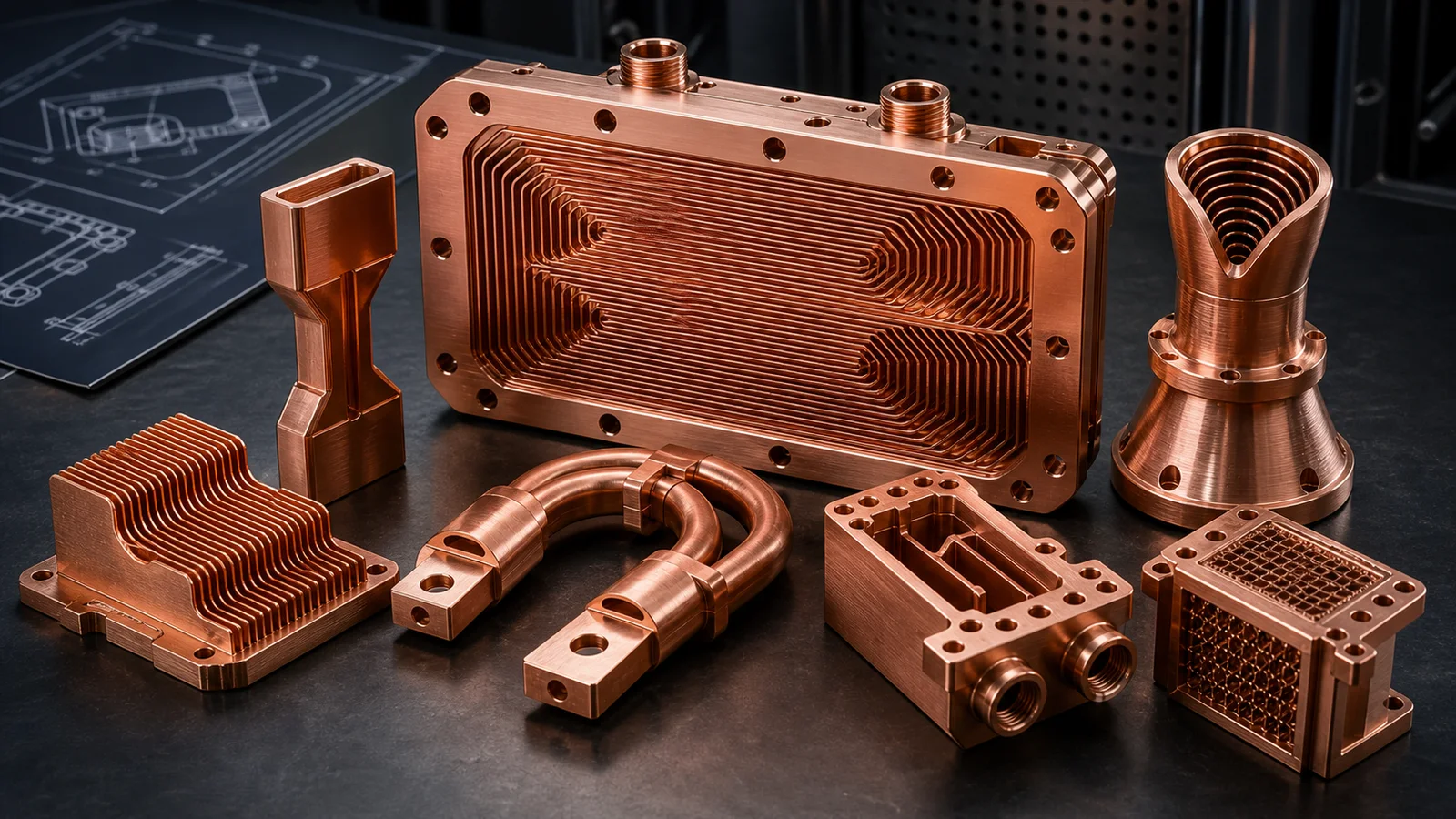
3D Printed Copper RF Waveguide and Vacuum Parts
RFQ guide for 3D printed copper RF waveguide, cavity, and vacuum components: conductive surfaces, sealing, cleaning, plating, and inspection inputs.
Working on a copper part? Start a project review — share a brief; CAD can follow.
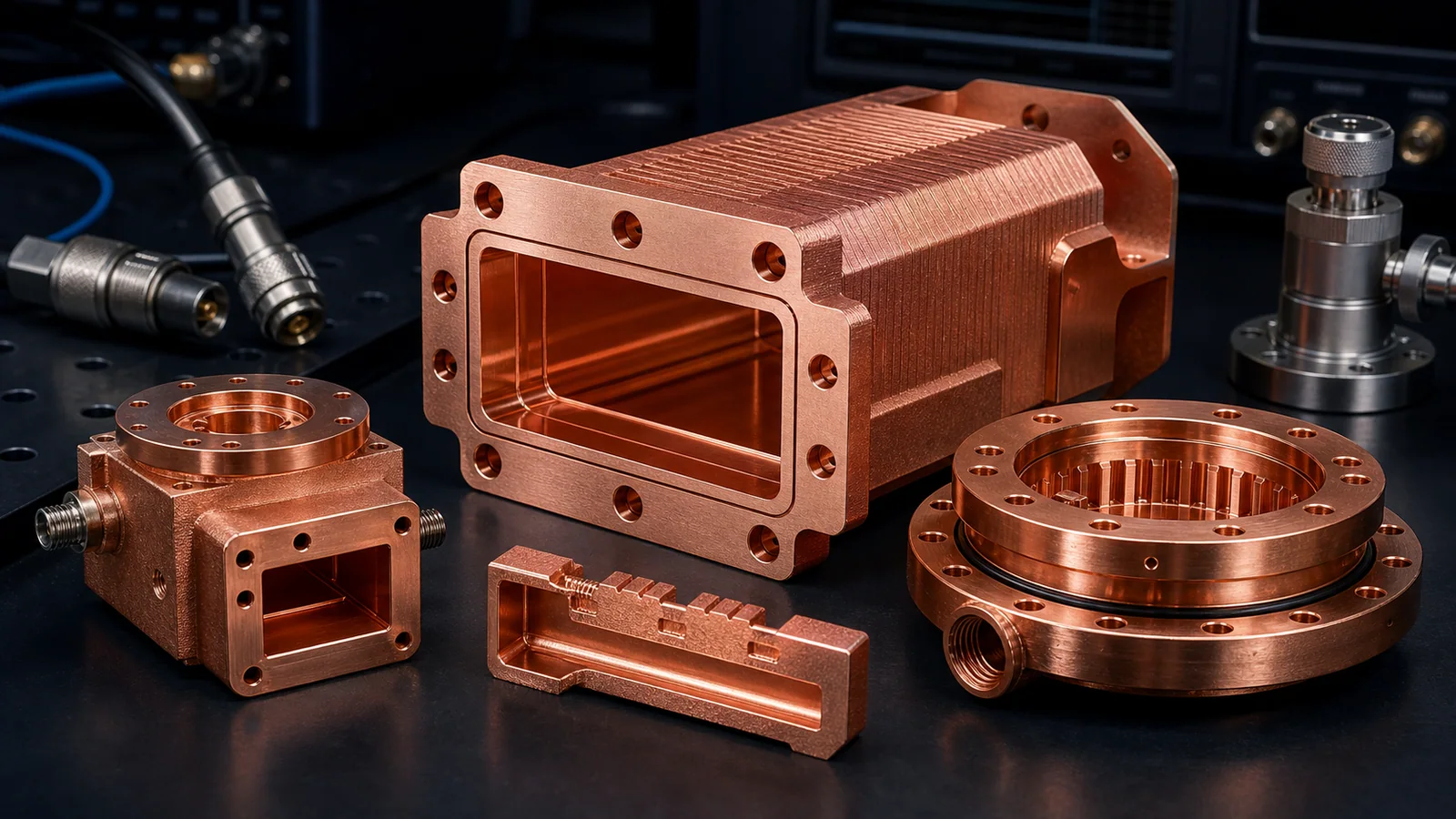
3D printed copper RF and vacuum parts are worth reviewing when geometry, consolidation, cooling, or package routing matters more than the simplicity of a conventional machined part. Send CAD, drawings, quantity, RF or vacuum requirements, critical surfaces, material preference, and inspection expectations. The quote depends on conductivity, surface condition, sealing, cleaning, and post-processing, not only on the printed shape.
Where Copper AM Can Help RF and Vacuum Hardware
RF waveguide, cavity, and vacuum components are usually interface-sensitive parts. A small geometry error, rough conductive surface, trapped powder pocket, or sealing issue can matter more than the mass of copper in the part. This makes them different from simple copper brackets or blocks.
Copper additive manufacturing can be useful when the part needs:
- Compact three-dimensional RF routing.
- Integrated cooling around an RF or vacuum structure.
- Part consolidation that reduces joints, alignment steps, or brazed interfaces.
- Internal cavities, transitions, manifolds, or complex non-line-of-sight geometry.
- Lightweighting or envelope control without giving up copper conductivity.
- Prototype hardware where design iteration is more important than lowest unit cost.
It is usually not the first route for simple straight waveguides, open machined cavities, or flat copper parts that can be made more directly by CNC machining.
Define the Function Before the Manufacturing Route
The same copper geometry can be reviewed very differently depending on whether the part is RF-critical, vacuum-critical, thermally loaded, or mainly structural. A useful RFQ starts with the function.
| Requirement | Why it changes the quote |
|---|---|
| Frequency band or RF function | Drives conductive surface, plating, and dimensional sensitivity |
| Waveguide or cavity interfaces | Drives flange geometry, machining, and inspection datum setup |
| Vacuum level or leak requirement | Drives sealing, cleaning, material condition, and leak testing |
| Thermal load | May require integrated cooling or conductivity review |
| Surface finish | Separates as-printed surfaces from machined or plated surfaces |
| Material preference | Pure copper, CuCrZr, or another alloy changes strength and conductivity |
| Quantity and maturity | Prototype, pilot, and repeat production need different risk controls |
| Acceptance test | Prevents a quote that omits the real pass/fail step |
If the frequency band, leak target, or acceptance test is still open, say so. A supplier can review geometry, but the quote should identify which assumptions were used.
Conductive Surfaces Are Not All Equal
For RF components, not every visible copper surface has the same importance. The RF path, mating interface, cavity wall, choke feature, flange face, or contact surface may need a different finish from non-critical outer geometry.
Identify:
- Which surfaces are part of the RF path.
- Which surfaces must be machined after printing.
- Whether plating or polishing is expected.
- Whether internal cavities are accessible for finishing.
- Which datums control alignment.
- Whether tuning, test fitting, or post-machining allowance is acceptable.
As-printed copper surfaces may be acceptable on non-critical areas, but RF-critical internal faces often need a defined post-processing route. If an internal surface is unreachable after printing, the RFQ should make that clear before pricing.
Vacuum Parts Need Cleaning and Leak Logic
Vacuum copper hardware adds a different set of risks. A part may be dimensionally correct and still be unsuitable if it traps powder, cleaning media, or contamination. For vacuum or sealed systems, state:
- Required leak test method, if known.
- Working pressure or vacuum condition.
- Bakeout or temperature exposure.
- Cleaning requirement and packaging expectation.
- Whether trapped volumes are allowed.
- Whether CT or flow verification is needed for hidden passages.
- Sealing faces, O-ring grooves, knife-edge interfaces, or gasket locations.
Avoid specifying “no leaks” without a test method or acceptance level. A practical RFQ should tell the supplier how leak acceptance will be judged.
Integrated Cooling Can Change the Entire Design Review
Many high-value RF and semiconductor copper parts are not only conductive. They also remove heat. If the component includes cooling, the quote needs the same information required for a cold plate:
- Coolant type.
- Flow rate or pressure drop limit.
- Working pressure and proof pressure.
- Inlet and outlet positions.
- Thermal load or hot-spot location.
- Cleaning and drying requirement.
- Leak, pressure, flow, or CT inspection scope.
See the microchannel heat exchanger RFQ guide when internal cooling is the main reason for additive manufacturing.
Material and Post-Processing Choices
Pure copper is often considered when electrical or thermal conductivity is the main driver. CuCrZr may be reviewed when strength, thread stability, clamp load, or temperature exposure matters. Material choice should follow the functional requirement, not only the phrase “copper part” on the drawing.
If pure copper is the preferred route, review Pure Copper 3D Printing: Applications, Benefits, and Manufacturing Challenges before quote release. RF and vacuum parts can be conductivity-driven, but pure copper still needs a qualified process route, reachable finishing surfaces, and acceptance evidence.
Post-processing may include:
- Stress relief or heat treatment.
- CNC machining of RF interfaces, flanges, datums, and sealing faces.
- Polishing or surface conditioning of selected conductive surfaces.
- Plating or coating when required by the RF or vacuum system.
- Cleaning, drying, and protected packaging.
- CMM, leak test, pressure test, conductivity, or RF-related inspection.
Use the materials page if the alloy is open, and include service conditions so the material review has enough context.
What Makes an RFQ Strong
A strong RFQ separates what is critical from what is merely visible. It does not over-specify every surface; it defines the surfaces and tests that decide acceptance.
Include:
| Input | Minimum useful detail |
|---|---|
| CAD | STEP, X_T, or native CAD with internal geometry included |
| Drawing | Critical dimensions, datums, flanges, sealing faces, and machining notes |
| RF requirement | Frequency band, interface type, cavity function, or test expectation if known |
| Vacuum requirement | Leak method, vacuum level, cleaning, bakeout, or trapped-volume concern |
| Quantity | Prototype, pilot, or batch quantity |
| Material | Pure copper, CuCrZr, or “please review” with operating condition |
| Post-processing | Machining, polishing, plating, cleaning, or inspection scope |
| Acceptance | CMM, leak, pressure, flow, RF test, or documentation requirement |
If only CAD and quantity are ready, send them. The quote may use assumptions, and focused clarification may follow.
Red Flags Before Quoting
Review these issues before treating a copper RF or vacuum component as a straightforward print:
- Critical RF faces are enclosed and cannot be machined or finished.
- The drawing does not identify conductive or sealing surfaces.
- Vacuum cleanliness is required but trapped volumes remain in the design.
- Leak testing is required but no method or acceptance is stated.
- The part includes cooling channels but no pressure, flow, or cleaning requirement.
- Material is specified only as “copper” with no conductivity, strength, or service condition.
- A simple CNC route would meet the function with less risk.
These points do not mean the part is a poor candidate. They mean the RFQ needs engineering review before a reliable quote.
Related RF, Vacuum, and Post-Processing Guides
For semiconductor tools, pair this page with Copper AM Parts for Semiconductor Equipment and the RF vacuum manifold design review. Those pages show how RF, vacuum, cleanliness, thermal control, and inspection requirements often overlap.
When the material decision is open, use pure copper 3D printing applications and limits and the copper alloy selection guide before locking pure copper, CuCrZr, or CuCr1Zr. When surface condition controls performance, review Copper 3D Printing Surface Finish Options, Plating and Finishing Copper AM Parts, and Post-Processing Methods for 3D Printed Copper Parts. If the part includes internal cooling or trapped passages, also review powder removal for copper AM internal channels.
Practical RFQ Email
For a 3D printed copper RF waveguide, cavity, or vacuum component quote, send CAD, drawing, quantity, RF or vacuum requirement, critical surfaces, material preference, post-processing expectation, and inspection or test requirements.
Send files to info@szcomo.com. A simple prototype may be quoted with stated assumptions. A field-critical RF, vacuum, or cooled part may need clarification before final pricing.
Copper AM quotation
Review an RF, waveguide, or vacuum part
Describe the component function and critical interfaces. Add frequency, surface, vacuum, and inspection requirements if known, with CAD or a drawing when available.
Before you submit: Copper RF and waveguide service.