Copper vs Aluminum for Cold Plates and Heat Sinks: When Copper Is Worth It
When copper earns its extra mass and cost in a cold plate or heat sink, when aluminum is the better engineering choice, and how heat flux, fin geometry, coolant loop metals and weight decide it.
Working on a copper part? Start a project review — share a brief; CAD can follow.
Copper is worth it when conduction inside the metal controls the temperature rise: high heat flux under a small device, a base that must spread heat sideways, or thin fins in a high heat-transfer coefficient liquid channel. Aluminum is usually the better choice when the air side, coolant side or thermal interface controls the rise, when mass matters, or when the rest of the coolant loop is aluminum. At room temperature, wrought copper conducts heat roughly 1.9 times better than EN AW-6063 T6 and about 2.5 times better than 6061-T6, but it is about 3.3 times as dense.
This guide is for engineers and buyers choosing the metal for a liquid cold plate or a heat sink, before deciding how to manufacture it. It answers one question: under which heat flux, fin, coolant and weight conditions does copper pay for its extra mass and cost, and when does aluminum do the job?
What it cannot settle without your inputs: the heat load and the footprint it enters through, the allowable device or case temperature, the coolant or airflow and its temperature, the other wetted metals in the loop, the mass budget and the expected quantity. For commercial reviews, see the copper cold plate and custom copper heat sink pages.
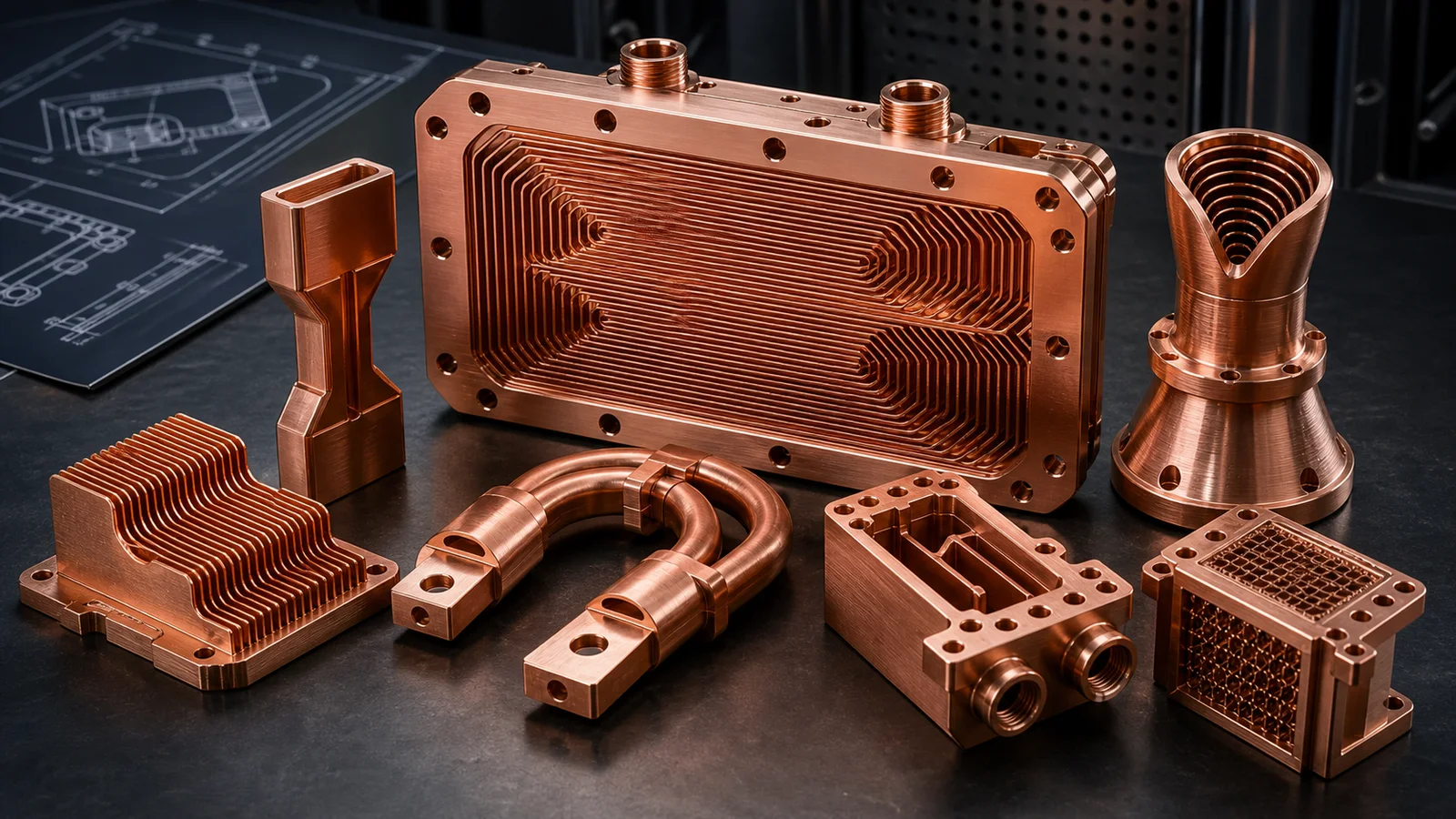
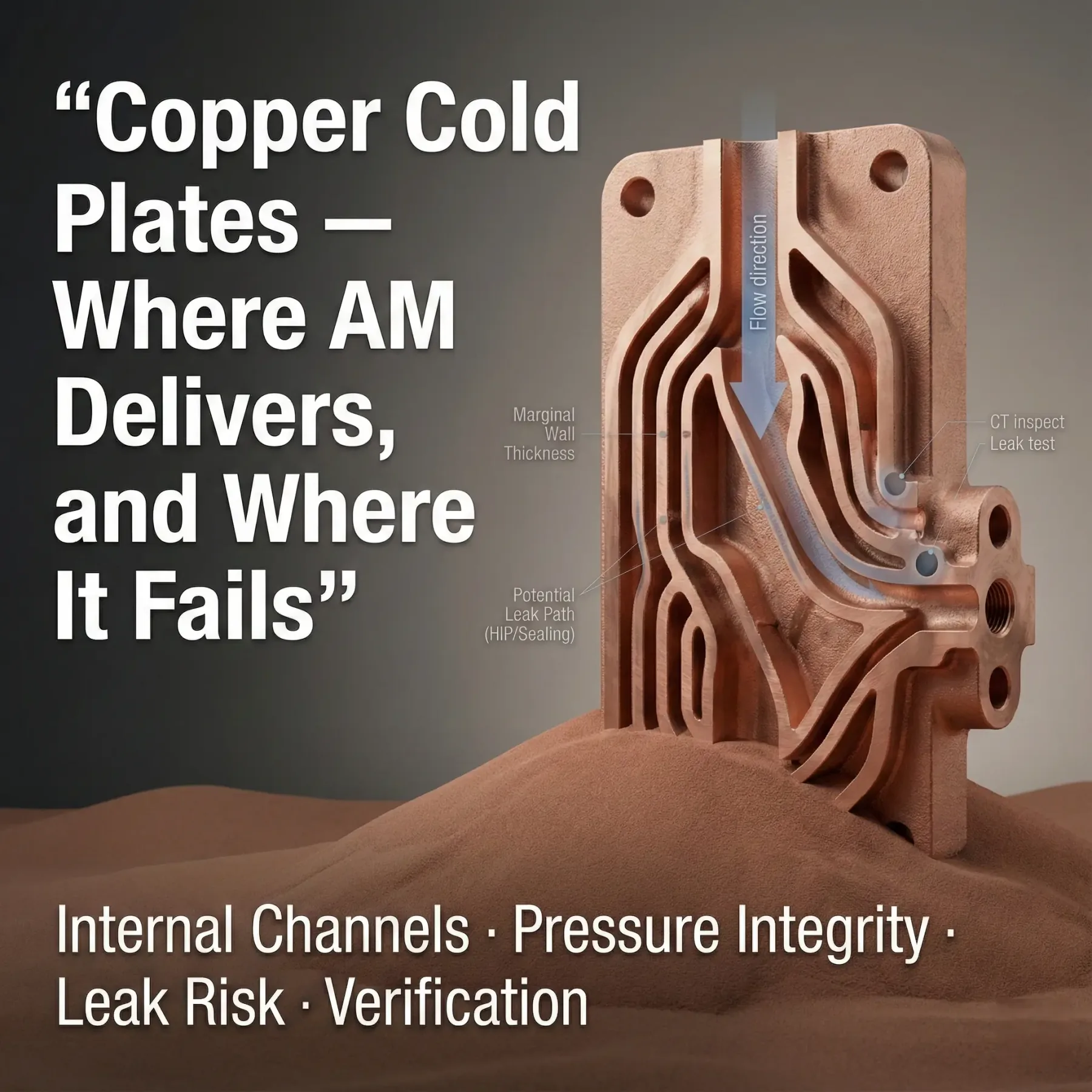
Cover: a reused reference image from this site’s library, not a photograph of a specific part or test. The chart below is an original calculated illustration, not measured data.
Quick decision table
| Condition | Usually favours | Why | What to verify |
|---|---|---|---|
| Small hot device, high heat flux into the base | Copper | Base conduction and spreading are a large share of ΔT | Footprint, flux, base thickness |
| Large footprint, moderate flux, air-cooled | Aluminum | Air-side resistance dominates; copper adds mass | Installed airflow, fan curve |
| Thin fins in narrow liquid channels | Copper | Fin efficiency falls faster with lower k | Fin thickness, channel h, pressure drop |
| Mass-limited (vehicles, airborne, handheld) | Aluminum | ~3.3× lower density | Thermal margin at the lower k |
| Loop already all-aluminum | Aluminum, or isolate copper | Copper ions can drive aluminum pitting | Coolant chemistry, wetted metals |
| Loop copper/stainless (e.g. OCP-style rack TCS loops) | Copper | Fits the commonly listed wetted metals | Coolant spec, filtration |
| Direct attach to a low-CTE device or substrate | Review case by case | Copper’s CTE is lower than aluminum’s | Bond layer, flatness, thermal cycling |
Read the table as a screening tool. The decision becomes clear once you know which thermal resistance in the stack is the largest.
The property numbers behind the decision
| Material (supplier data, room temperature) | Thermal conductivity | Density | Linear expansion |
|---|---|---|---|
| Cu-ETP, EN CW004A / UNS C11000 (Wieland K18/K32) | > 385 W/(m·K) | 8.93 g/cm³ | 17.7 × 10⁻⁶/K (0–300 °C) |
| Cu-OF, UNS C10200 (Wieland K30) | > 394 W/(m·K) | 8.94 g/cm³ | 17.7 × 10⁻⁶/K (0–300 °C) |
| EN AW-6063 T6 extrusion (Hydro) | 201 W/(m·K) | 2.70 g/cm³ | 23.5 × 10⁻⁶/K |
| 6061-T6 (NIST cryogenic data, value at 293 K) | ≈ 154 W/(m·K) | — | — |
The 6061-T6 value is our evaluation of NIST’s published curve fit at 293 K. All values are typical reference values for wrought material from the cited sources, not guaranteed properties of a finished part. Hydro’s 6063 datasheet notes that the alloy is commonly used for heat sinks.
Two ratios follow from these numbers:
- Per unit volume, copper conducts about 1.9 times better than 6063-T6 and about 2.5 times better than 6061-T6.
- Per unit mass, aluminum conducts better. Conductivity divided by density is about 43 for Cu-ETP and about 74 for 6063-T6 (in W·cm³/(m·K·g)). If the design can simply use more aluminum, for example a thicker base or thicker fins, it can be lighter for the same conduction.
So the real question is not which metal conducts better, but whether the part has the room to compensate for lower conductivity with more metal.
Where copper’s conductivity actually lowers the temperature
1. Conduction through and across the base
Heat entering a cold plate or heat sink base must cross its thickness and spread out from the device footprint. Both resistances scale with 1/k. The chart below uses the simplest one-dimensional case, uniform heat flux through a 3 mm base with no spreading, to show the scale.
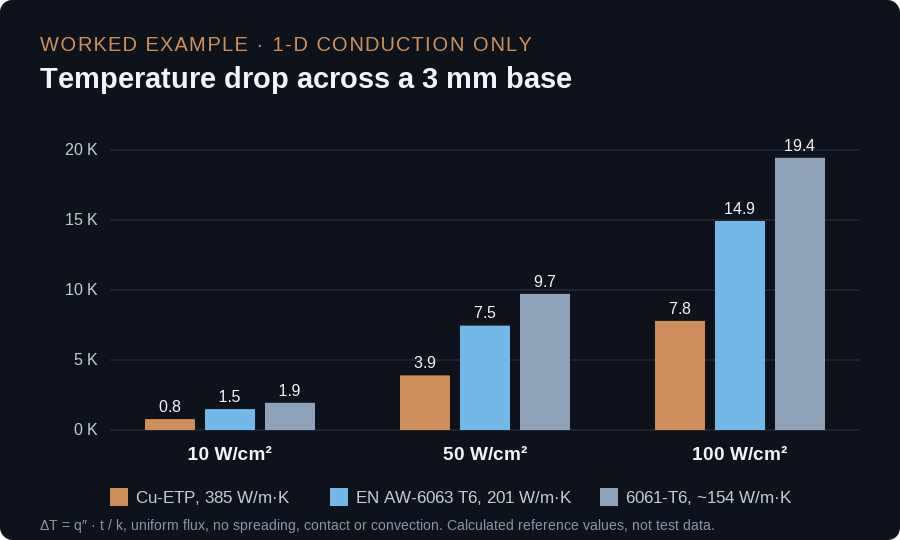
At 10 W/cm² the difference between copper and 6063 is under 1 K, which is usually small next to the interface and convection drops. At 100 W/cm² it is about 7 K, and against 6061 about 12 K, which can be the whole margin. A real device that is smaller than the base adds spreading resistance, which also scales with 1/k, so the copper advantage under a small hot spot is normally larger than this one-dimensional example shows.
2. Fin efficiency
A fin works less well towards its tip because heat must conduct along it. For a straight fin with an insulated tip, the fin efficiency is η = tanh(mL)/(mL), with m = √(2h/(k·t)) for thickness t, height L and heat-transfer coefficient h (Lienhard and Lienhard, A Heat Transfer Textbook, section 4.5). We calculated two illustrative cases with assumed values of h:
| Case (assumed inputs) | Cu-ETP | 6063-T6 | 6061-T6 |
|---|---|---|---|
| Air fin, 1 mm thick, 30 mm tall, h = 50 W/(m²·K) | 0.93 | 0.87 | 0.84 |
| Liquid fin, 0.3 mm thick, 3 mm tall, h = 10,000 W/(m²·K) | 0.68 | 0.54 | 0.49 |
In typical forced-air heat sinks the material changes fin efficiency by only a few percentage points; airflow, fin spacing and bypass matter more. In fine liquid-cooled fin fields, where h is high and fins are thin, copper keeps substantially more of each fin working. An aluminum design can recover efficiency with thicker fins, at the cost of fewer channels or a higher pressure drop.
For fin geometry limits, see copper heat sink fin thickness and spacing.
3. What copper does not change
Copper does not reduce the thermal interface resistance, the contact pressure problem, the coolant’s heat capacity or the fan’s operating point. If the largest resistance is the thermal interface material or air-side convection, switching to copper mostly adds mass and cost. Measure or model the resistance stack first.
Coolant loop and galvanic compatibility
The metal choice for a liquid cold plate is a loop decision, not only a part decision.
- Copper ions and aluminum do not mix well. A Hungarian Scientific Research Fund (OTKA) project report (Bakos and Szabó, 2007) found that copper galvanically connected to aluminum can cause vigorous pitting of the aluminum in aerated, chloride-containing solutions, and that dissolved copper ions have the same effect because copper deposits on the aluminum surface. In their chloride-free and deaerated conditions, the attack was absent or reduced. Coolant chemistry and inhibitors change the risk; they do not make the couple irrelevant.
- Data-centre liquid-cooling guidance is written around copper and stainless loops. The Open Compute Project’s 2026 guideline for propylene-glycol (PG25) heat-transfer fluids lists copper, low-zinc brass, stainless steel, nickel, chromium, titanium and copper- or nickel-based brazes as commonly used wetted metals. Aluminum is not in that list. The same guideline sets copper in the fluid at < 3 ppm (ASTM D6130), with closer monitoring above 5 ppm.
Practical rule: in a loop that is already copper and stainless, a copper cold plate fits; adding an aluminum plate needs explicit coolant and corrosion review. In a loop that is already aluminum (radiators, housings, pumps), a copper plate needs the same review, electrical isolation where possible and a coolant qualified for the mixed metals. The detailed coolant, coating and corrosion-test plan is covered in coolant chemistry and galvanic risk in copper cold plates.
Weight, expansion and mounting
- Mass. At the same geometry, copper is about 3.3 times heavier. On a rack-mounted cold plate this rarely matters; on a vehicle, airborne or handheld product it can decide the material before thermal analysis does.
- Thermal expansion. Copper’s expansion coefficient (17.7 × 10⁻⁶/K) is lower than 6063’s (23.5 × 10⁻⁶/K). Where a cold plate or base is bonded or soldered to a low-expansion device or ceramic substrate, the mismatch, bond layer and thermal cycling must be reviewed. Neither metal is automatically safe.
- Flatness and clamping. Both metals need a machined, specified contact face. Softer annealed copper and aluminum can both deform under clamping loads; state flatness and surface finish in the final state, after any heat treatment.
Manufacturing routes change the comparison
The material decision and the manufacturing route interact:
- Aluminum has mature, low-cost routes for heat sinks and cold plates: extruded and skived fins, brazed assemblies, tube-in-plate designs and friction-stir-welded covers. For moderate heat flux and medium or high quantities, these are hard to beat on cost.
- Copper is available as machined, skived, brazed or tube-embedded designs, and by laser powder bed fusion (LPBF) when internal channels, manifolds or fin fields cannot be machined or brazed reliably.
- Printed copper is not wrought copper. Delivered conductivity depends on powder, process, density, heat treatment and test method. Specify the finished conductivity and how it is measured rather than assuming the wrought values above; see specifying pure copper LPBF parts by finished conductivity.
- Printed aluminum is not 6063. Printed aluminum alloys such as AlSi10Mg are different materials from extrusion alloys. If a printed aluminum part is the alternative, ask its supplier for thermal conductivity data in the delivered state rather than reusing 6063 values.
Printing copper only makes sense when the copper is needed (high flux, fine liquid fins, copper-based loop) and the geometry needs printing. If either condition is missing, a conventional route is usually better.
Performance vs acceptance
Keep reference values and drawing requirements separate.
| Item | Reference value (screening) | What the drawing or purchase order should state |
|---|---|---|
| Thermal conductivity | Supplier data for wrought grades (table above) | Material grade and state; for printed parts, minimum conductivity with method and specimen |
| Thermal performance | Calculated ΔT or thermal resistance from a model | Thermal resistance or case temperature at stated flow, inlet temperature and load |
| Pressure drop | Model or correlation | Maximum ΔP at stated flow and fluid |
| Corrosion compatibility | Literature and coolant supplier guidance | Coolant spec, wetted-metal list, corrosion test or field approval |
| Mass | Geometry × density | Maximum mass, if it matters |
| Interface | — | Flatness, roughness and finish of the contact face in the final state |
A material certificate proves the metal, not the thermal result. The functional test, a thermal resistance measurement on the agreed rig with the agreed coolant and flow, is what closes the decision.
When copper is not worth it
- The air side dominates. Large footprint, moderate flux, forced or natural air: an aluminum extrusion or skived design usually performs close to a copper design with much less mass.
- The interface dominates. If the TIM or contact resistance is the largest term, fix that first.
- The loop is aluminum and cannot change. Mixing in copper adds corrosion risk that may cost more than the thermal gain.
- Mass is a hard limit. Use aluminum and spend the volume on a thicker base or more fins, or look at heat pipes or vapor chambers.
- Volume is high and geometry simple. Extruded, skived or brazed aluminum is mature and economical.
And when copper is worth it but printing is not: a simple drilled, skived or brazed copper plate that meets the duty is usually cheaper and easier to qualify than an LPBF part. The monolithic vs brazed copper cold plate guide compares those copper routes.
RFQ checklist
Send what you have and mark unknowns as pending:
- CAD and drawing, with the device footprint(s) and contact faces identified.
- Heat load per device, footprint area and the resulting heat flux; steady or transient.
- Maximum allowable device, case or base temperature.
- Cooling medium: airflow and fan curve, or coolant type, flow, inlet temperature and allowable pressure drop.
- All other wetted metals in the loop, coolant specification and any corrosion requirements.
- Material preference (copper grade, or open to aluminum) and the reason for it.
- Mass limit, if any.
- Design and proof pressure, leak test method and acceptance (liquid cold plates).
- Flatness, roughness and finish of contact faces in the final state.
- Thermal acceptance: who tests, on which rig, at which conditions.
- Quantity, prototype and repeat-build plan, and target date.
Submit through the secure RFQ form. We review whether the duty actually needs copper, and whether it needs printing, before quoting; if a conventional copper or aluminum route fits better, we say so.
Sources and scope
Sources were reviewed on 4 November 2026. Property values are typical room-temperature reference values for wrought material from the cited suppliers and NIST; they are not guaranteed values for any finished or printed part. The conduction and fin-efficiency figures are our calculations from standard formulas with the stated, assumed inputs; they are illustrations, not measured results. The corrosion findings are published third-party research and guidance, not COPPER 3DP test data. No prices, lead times, tolerances or performance guarantees are given here.
- Wieland, K18/K32 Cu-ETP datasheet: thermal conductivity, density and expansion of Cu-ETP.
- Wieland, K30 Cu-OF datasheet: thermal conductivity, density and expansion of Cu-OF (C10200).
- Hydro, Technical datasheet, EN AW-6063 extruded products (Rev. 4, 2023): 6063-T6 thermal conductivity, density, expansion; heat-sink use.
- NIST, Cryogenic material properties: 6061-T6 aluminum: thermal conductivity curve fit, 4–300 K.
- J. H. Lienhard IV and J. H. Lienhard V, A Heat Transfer Textbook, 6th ed., section 4.5: fin efficiency.
- Open Compute Project, Guidelines for using propylene glycol-based heat transfer fluids in liquid cooled racks, Rev. 2.0 (2026): commonly used wetted metals (section 6.3) and copper monitoring limit.
- I. Bakos and S. Szabó, Corrosion properties of the copper-aluminium metal couple, OTKA project report (2007), in Hungarian with English summary: galvanic and copper-ion-induced pitting of aluminum.
Copper AM quotation
Review a copper cold plate or cooling part
Describe the cooling problem and available space. Add a sketch or CAD, coolant, heat load, and flow or pressure limits where known; leave open requirements for review.
NDA available on request. We reply within 2 business days.
Before you submit: Custom copper cold plate service.