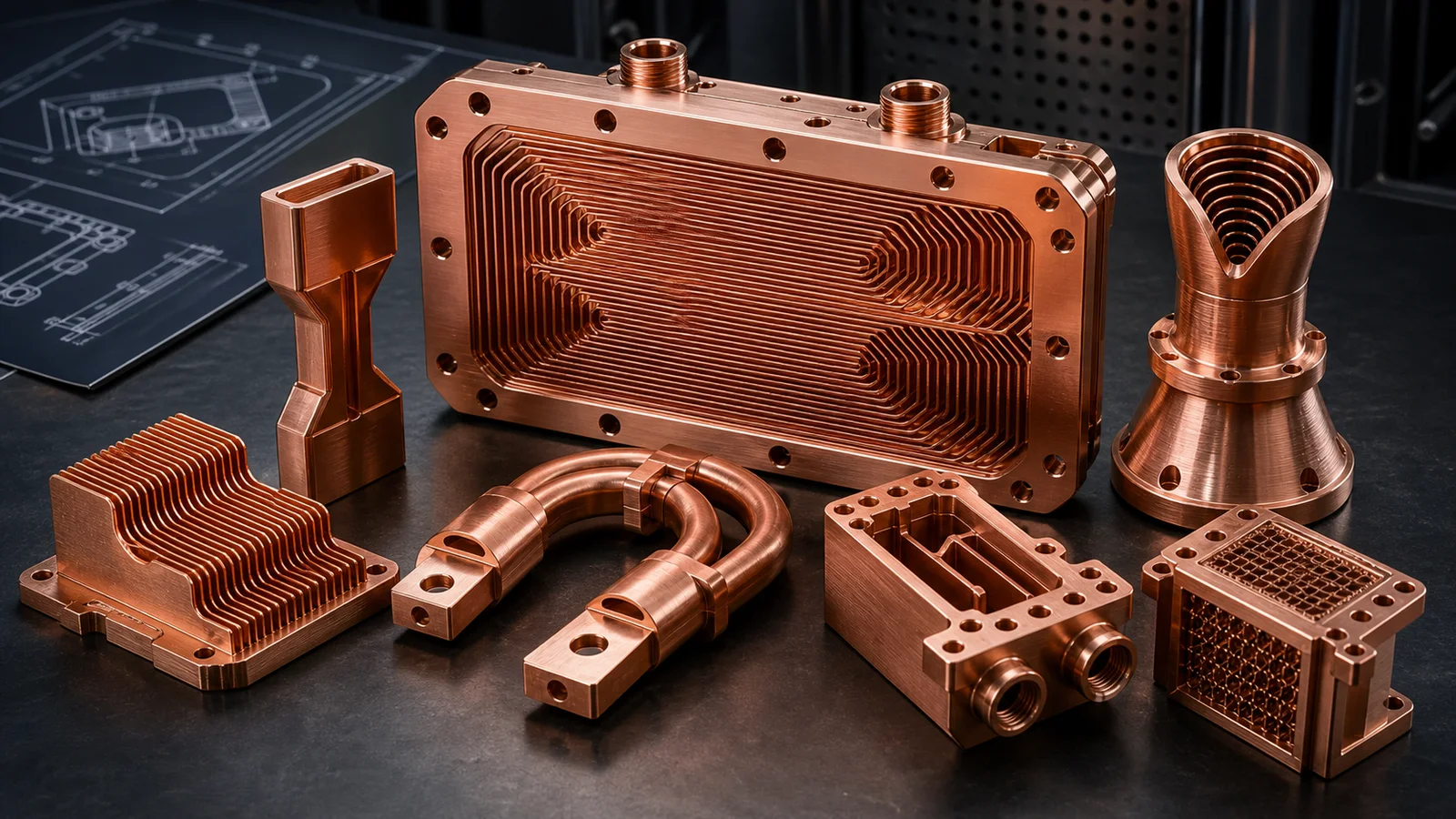
GRCop-42 vs CuCrZr vs Pure Copper for 3D Printed High-Heat-Flux Parts
How to choose between GRCop-42 (Cu-4Cr-2Nb), CuCrZr (CuCr1Zr / C18150), and commercially pure copper for LPBF parts based on service temperature, strength retention, conductivity, heat treatment, and supply constraints.
Working on a copper part? Start a project review — share a brief; CAD can follow.
Choosing between GRCop-42, CuCrZr (CuCr1Zr / C18150 / CW106C), and commercially pure copper is not a conductivity ranking exercise. It is a decision about peak operating temperature, mechanical load, thermal cycling, qualification budget, and supply-chain lead time.
- Choose commercially pure copper when bulk thermal or electrical conductivity is the primary performance driver, service temperatures stay moderate, and mechanical loads (threads, clamp forces, pressure boundaries) can be controlled through wall thickness or supporting hardware.
- Choose CuCrZr / CuCr1Zr when an industrial thermal, electrical, or tooling part needs both useful conductivity and higher yield strength, hardness, and resistance to softening—such as pressurized cold plates, bolted manifolds, induction coils, or conformal cooling mold inserts.
- Choose GRCop-42 (Cu-4Cr-2Nb) only when sustained elevated temperature, extreme heat flux, creep resistance, and oxidation/thermal-fatigue stability exceed what precipitation-hardened CuCrZr can hold—typically propulsion combustion liners, nozzles, and specialized aerospace thermal structures.
If your drawing has not locked service temperature, working/proof pressure, and acceptable alloy equivalents yet, leave the final alloy route open for engineering review rather than specifying an aerospace alloy out of habit.
Engineering decision matrix: Pure Copper vs CuCrZr vs GRCop-42
| Decision factor | Pure Copper LPBF | CuCrZr / CuCr1Zr LPBF | GRCop-42 (Cu-4Cr-2Nb) LPBF |
|---|---|---|---|
| Strengthening mechanism | Single-phase copper (no precipitation strengthening) | Precipitation hardening (Cr/Zr-rich precipitates formed during aging) | Dispersion strengthening via thermally stable Cr₂Nb intermetallic precipitates |
| Conductivity priority | Highest AM conductivity candidate when density and oxygen are controlled | Good useful conductivity after aging; lower than pure copper | High conductivity for a high-temperature alloy, below pure copper |
| Strength at room temperature | Soft; threads, thin fins, and high clamp loads need extra margin | Significantly stronger and harder after controlled aging | Strong, with superior ductility-strength retention across thermal cycles |
| Elevated-temperature stability | Softens readily under sustained heat and load | Over-ages and loses strength if held above its aging temperature window | Retains strength and creep resistance at substantially higher service temperatures |
| Typical thermal post-process | Stress relief or annealing per conductivity/distortion needs | Stress relief + controlled solution/aging sequence before finish CNC | Stress relief and/or HIP (Hot Isostatic Pressing) per qualification specification |
| Feedstock & commercial lead time | Broad industrial availability; fastest prototype-to-batch route | Broad industrial availability across standard C18150 / CW106C equivalents | Specialized powder supply, higher feedstock cost, longer lead time, and stricter export/end-use screening |
| Typical best-fit hardware | High-conductivity cold plates, busbars, RF waveguides, vacuum hardware | Pressurized cold plates, manifolds, induction coils, conformal mold inserts | Rocket combustion chambers, regen-cooled nozzles, extreme heat-flux aerospace liners |
Note: Material comparisons above are engineering screening boundaries based on published copper AM literature and OEM/agency technical references. Final conductivity, tensile, hardness, and density acceptance values depend on powder lot, laser route, orientation, heat treatment/HIP, and specimen test method, and must be confirmed per drawing in the quotation.
Why service temperature separates CuCrZr from GRCop-42
The most common specification mistake in high-heat-flux RFQs is assuming CuCrZr and GRCop-42 behave similarly at elevated temperatures.
- CuCrZr gets its strength from fine precipitates formed during artificial aging. In room-to-moderate-temperature industrial service—such as liquid-cooled AI cold plates, power-electronics blocks, and water-cooled mold inserts—those precipitates remain stable and deliver an effective balance of strength and thermal conductivity. However, if the component operates continuously near or above its aging temperature range (or undergoes high-temperature brazing), the precipitates coarsen (“over-aging”), reducing yield strength and hardness.
- GRCop-42 (Cu-4Cr-2Nb), developed by NASA Glenn Research Center for regeneratively cooled rocket engine chambers, uses Cr₂Nb intermetallic dispersions that resist coarsening at much higher temperatures. Because Cr₂Nb phases stay stable during high-temperature thermal cycling and HIP processing, GRCop-42 resists creep and low-cycle thermal fatigue where CuCrZr would soften.
For industrial electronics cooling, RF hardware, or injection-mold tooling where coolant keeps metal temperatures well below CuCrZr’s over-aging threshold, specifying GRCop-42 rarely improves part performance enough to justify its higher powder cost, specialized parameter qualification, and longer lead time.
Heat treatment, HIP, and machining sequence
Across all three routes, “as-built” is almost never the final delivered condition for a functional component:
- Pure copper: Plan stress relief (if geometry or thin walls require dimensional stability) before final CNC machining of flatness datums, O-ring grooves, and electrical contact pads. Review pure copper 3D printing service requirements when conductivity evidence is critical.
- CuCrZr / CuCr1Zr: Never finish-machine tight sealing lands or tapped ports before precipitation aging. Thermal cycles change both dimensions and conductivity; lock the aging sequence and witness-coupon checks first. See CuCrZr 3D printing service scope and heat treatment for CuCrZr components.
- GRCop-42: High-pressure aerospace and high-heat-flux liners commonly pair LPBF with Hot Isostatic Pressing (HIP) to close residual internal porosity before final machining, internal channel verification, and proof/leak testing. Because HIP and machining stock interact with thin cooling walls, wall-thickness margins must be planned in CAD from day one.
Internal channels, depowdering, and NDT still govern feasibility
Changing from pure copper to CuCrZr or GRCop-42 does not relax powder-removal or inspection physics:
- Narrow regenerative or microchannel passages still require continuous drainage paths, realistic bend radii, and zero blind dead-ends.
- High-pressure cooling circuits still require defined working pressure, proof pressure, leak-test method (pressure decay or helium mass spectrometer), flow/ΔP acceptance, and CT sampling where internal wall integrity cannot be inspected externally.
- If a cooling channel cannot be depowdered, flushed, and verified, a stronger alloy will not rescue the design.
Review proof pressure, helium leak, and flow test acceptance methods before freezing your inspection callouts.
Commercial supply, cost, and export-compliance screening
Before issuing a formal purchase order for GRCop-42 or high-heat-flux propulsion hardware, engineering and purchasing teams should verify two non-geometric constraints early:
- Commercial availability & MOQ: Pure copper and CuCrZr are routinely scheduled across industrial 532 nm green-laser LPBF platforms for single prototypes and repeat batches. GRCop-42 / CuCrNb builds often require dedicated powder lots, machine changeovers, and higher minimum build commitments.
- Export control & end-use documentation: Aerospace propulsion liners, thrust chambers, and dual-use high-temperature hardware may be subject to export licensing and end-use review depending on jurisdiction and application. Review export compliance considerations for 3D printed copper rocket parts before setting tight delivery milestones.
When to stay with conventional wrought copper or another route
LPBF is not automatically the right choice for any of these three materials:
- Simple flat plates, bars, or accessible drilled blocks: Wrought C10100/C11000 pure copper or C18150 CuCrZr bar stock machined by CNC provides mature mill certifications and lower unit cost.
- High-volume standardized parts: Hard tooling, stamping, skiving, or vacuum-brazed assemblies often win on per-part economics once design geometry is frozen.
- Extreme operating temperatures beyond copper alloys: When oxidation or structural loads exceed copper-alloy limits altogether, nickel-base superalloys or refractory/ceramic-lined architectures may be required.
Actionable RFQ checklist for high-heat-flux copper parts
To get a grounded engineering review and scoped quotation—rather than guesswork—include:
- CAD & 2D drawing: STEP or native CAD plus critical dimensions, flatness datums, ports, threads, and surfaces needing CNC stock.
- Operating envelope: Peak metal temperature, heat flux / heat load, coolant type, inlet temperature, and thermal-cycling duty.
- Mechanical & pressure loads: Working pressure, proof pressure, bolt-clamping loads, and any vacuum or leak-rate targets.
- Alloy preference or open review: State Pure Copper, CuCrZr / CuCr1Zr (C18150 / CW106C), or GRCop-42—or mark “open to engineering recommendation.”
- Thermal & post-processing scope: Stress relief, aging, HIP, CNC machining, polishing, plating, or cleaning requirements.
- Acceptance evidence: Witness coupons (conductivity, hardness, tensile, density), CMM, CT scan, proof pressure, helium leak, or flow/ΔP reports.
- Commercial inputs: Prototype and repeat-batch quantities, target delivery window, and end-use/compliance context.
Compare full material routes on our copper 3D printing materials overview or submit your CAD and thermal brief directly via the secure online RFQ form.
References
- NASA Technical Reports Server (NTRS): Development and Additive Manufacturing of GRCop-42 Copper Alloy (NASA Glenn Research Center) — Public agency research context on Cu-4Cr-2Nb dispersion-strengthened copper alloys for high-heat-flux propulsion hardware.
- EOS: Copper and CopperAlloy CuCrZr Materials — Official industrial material and heat-treatment context for pure copper and CuCrZr LPBF.
- TRUMPF: Green-Laser Copper LPBF Process Context — Official process context for 532 nm green-laser additive manufacturing of reflective copper alloys.
- ISO/ASTM: ISO/ASTM 52908:2023 — Qualification, post-processing, and testing framework for powder bed fusion metallic parts.
Copper AM quotation
Need to choose a copper material for a part?
Describe the part, operating environment, and properties that matter. State the material preference only if decided; material state and acceptance can be reviewed together.
NDA available on request. We reply within 2 business days.
Before you submit: Copper materials and delivered condition.